What Is Pattern of Life Security? Why Identity-First Threat Detection Matters
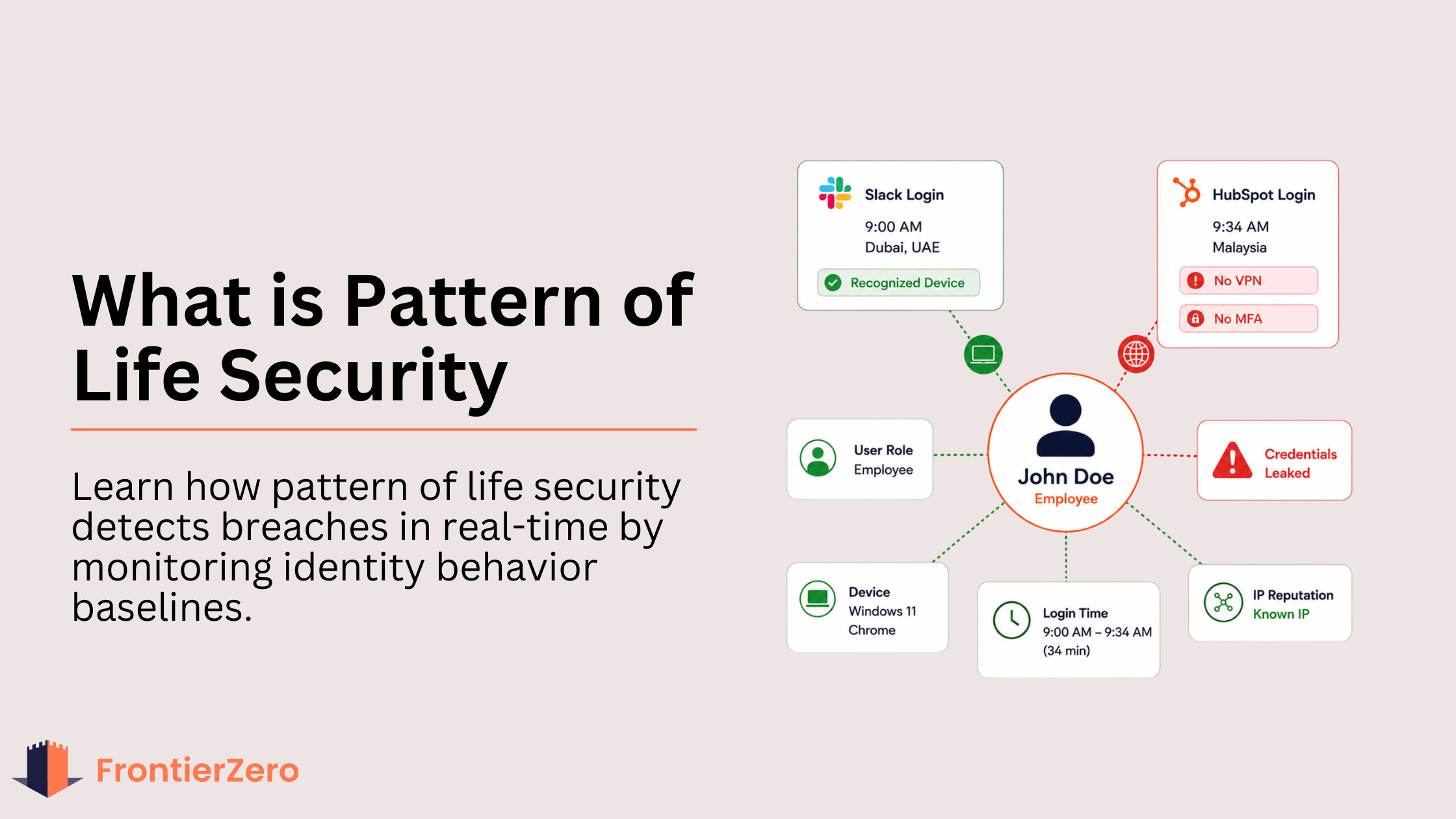
Hackers don't hack. They log in.
This single truth rewires how you should think about breach prevention. Every credential that leaks, every account that gets compromised, follows a pattern. Your legitimate users also have a pattern. The gap between them is where breaches live, and where most security tools stay blind.
Pattern of life security is the practice of understanding and monitoring the legitimate behavioral baseline of every identity in your organization, then detecting anomalies before damage occurs.
Think of it like an intruder alarm for your digital identities.
Your alarm won't help prevent people from entering, but it will alert you when that happens so you can make the correct decisions faster.
Your Finance Director logs in from Dublin at 9 AM on weekdays, using a MacBook on the company VPN. That's her pattern. If, at 2 AM, a login appears from her account from Kazakhstan from an unrecognized device with no VPN, you know that there is a problem.
But here's the problem: most security tools watch only one door. They see the Salesforce login but miss the Google Workspace login from a different continent three minutes earlier. They catch isolated anomalies, not coordinated attacks.
Pattern of life security connects all the doors. It creates a unified, identity-first view of who is logging in, where, when, and what they're accessing, across all your systems simultaneously. When patterns break, you know immediately.
Why Traditional Security Misses Breaches
Your current security stack was built for a different era. Firewalls and SIEMs work great when threats come from outside the perimeter. Today's reality is different.
Shadow SaaS blinds you. Your employees use Salesforce, NetSuite, Zendesk, HubSpot, Google Workspace, and dozens of other systems. Your SIEM typically sees one or two. An attacker with compromised credentials logs into all of them in minutes: stealing customer data from NetSuite, scraping emails from Google, building target lists from HubSpot. Each login is invisible to your other tools. To your SIEM, these are three separate events. To threat actors, it's one coordinated breach.
Compromised credentials look legitimate. Your employee's password leaked in a third-party breach. An attacker logs in using valid credentials at 1 AM from Russia. No malware. No exploit. Just legitimate-looking activity. Traditional tools don't ask: "Was this credential compromised? Is this login location consistent with this user's history? Is this device known to this user?" By the time your SIEM fires an alert, the attacker is already inside.
Lateral movement uses valid access. A phishing email compromises a junior accountant. The attacker pivots to Finance, then Executive systems, then R&D. They're using valid credentials and accessing systems the accountant should have access to. Without pattern of life context, this looks normal. With it, you see the accountant working nights (outside baseline), accessing systems they never touch (outside baseline), from a device they've never used (outside baseline). That's the signal that catches lateral movement during the attack, not after the breach is done.
How Pattern of Life Catches Breaches: A Real Example
A marketing coordinator's credentials leak in a third-party breach. An attacker tries her email/password on your Google Workspace. It works. They log in at 1 AM from Russia, using a device they've never seen before, and immediately start downloading emails from shared inboxes.
What your SIEM sees: A successful login. Maybe a risky login alert if it has behavior analysis, but in large organizations, these fire dozens of times per day. Noise.
What pattern of life security sees simultaneously:
- Credential is in a leaked credentials database (compromised)
- Login time (1 AM) is outside baseline (works 9 AM–6 PM)
- Login location (Russia) is outside geography (always UAE)
- Device is unknown (never before seen)
- Access pattern is immediate file exfiltration (not normal email reading)
Action: Force user logout.
The pattern is the key. Not the single anomaly, but the convergence of anomalies across identity dimensions (time, location, device, credential status, behavior).
This same pattern-based logic catches lateral movement (compromised accountant's credentials accessing Finance systems at 11 PM from unknown devices), supply chain attacks (a vendor account that hasn't been active for 6 months suddenly logging in from Nigeria), and insider threats (an employee starts downloading a lot more files than usual).
Traditional security tools see each event in isolation. Pattern of life security sees the unified identity story across all your systems simultaneously.
The Challenge: Unified Data Across Silos
Pattern of life security requires seeing every identity, every login, every application access simultaneously. But your Salesforce logs live in Salesforce. Your Google logs live in Google. Your HubSpot logs live in HubSpot. Your VPN has separate logs. Your identity provider has separate logs.
Stitching these together with API integrations is expensive and slow. SIEM aggregation creates blind spots if a system isn't connected. And even if you solve this, you face a deeper problem: most tools don't correlate across dimensions.
A user logs in from two locations 40 minutes apart, but the tools don't see it as impossible travel because the logins are in different systems. A credential appears in Have I Been Pwned, but the tool doesn't check if it's currently being used. An external partner account accesses new systems, but there's no context about whether the partner's environment was breached.
Pattern of life security demands unified identity architecture.
The FrontierZero Approach
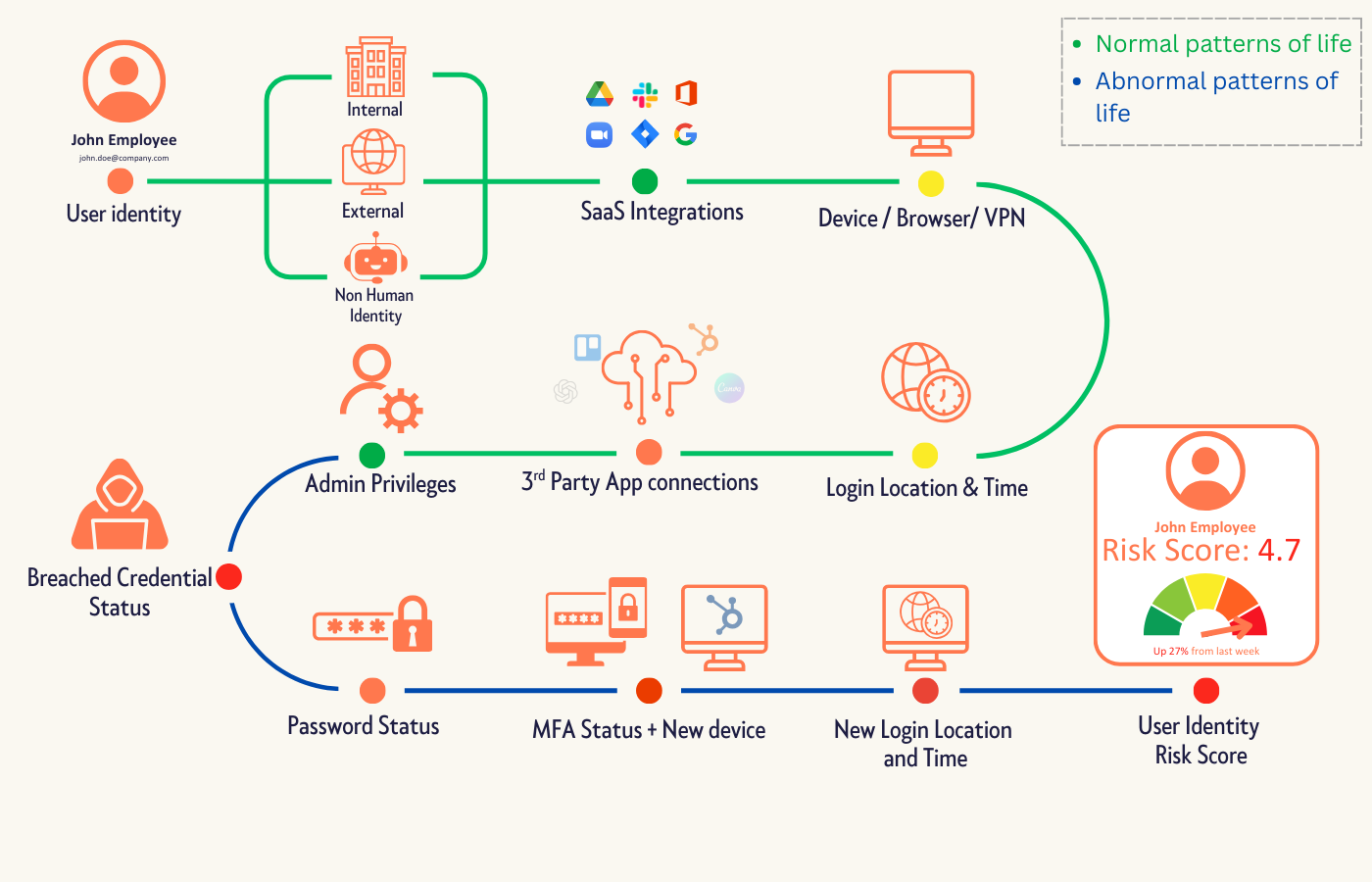
FrontierZero builds pattern of life detection around a single principle: understand identity baselines, then detect deviations in real time, across all your systems.
Unified Identity Timeline
FrontierZero ingests logs from every identity-relevant system: SaaS applications, identity providers, VPNs, corporate networks, and even the unapproved SaaS apps. It stitches them into one unified identity timeline. Your Finance Director who logs into Google at 9 AM is the same person who accesses HubSpot at 9:40 AM and Salesforce at 10 AM. FrontierZero sees all three as one identity, one timeline.
Identity Classification
Not all identities behave the same. FrontierZero classifies every identity:
- Human identities: employees
- External identities: contractors, partners, vendors
- Non-human identities: service accounts, API keys, automation
A service account logging in five times per day is abnormal if the baseline is once per week. A human user logging in from different countries is normal if he uses VPN or travels, but it is abnormal if he’s in the office but 10 minutes later logs in from Malaysia on a different app. A vendor account with randomized access patterns is abnormal if you have the data on when he typically logs in.
Multidimensional Baselines
Pattern of life establishes baselines across: login time and cadence, geography, device types, VPN usage, application scope, and behavior within applications. A seasoned executive's pattern includes travel (office M–F, KSA weekends). An off-hours login from Russia without travel indication is a deviation.
Cross-Application Anomaly Detection
Here's the power: your Finance Director logs into QuickBooks at 9 AM (Dubai), Google at 9:03 AM (Malaysia), HubSpot at 9:08 AM (Dubai). Three different systems. But FrontierZero sees one impossible travel anomaly: one identity, three simultaneous locations. This is account compromise. A traditional SIEM flagging each login separately creates noise. FrontierZero's unified view creates certainty.
Compromised Credential Integration
FrontierZero monitors over 20B+ dark web records. When your credentials leak, it knows. Then it correlates: Is this compromised credential being used right now? From where? At what time? An off-hours login from a known-compromised credential in an unusual geography isn't ambiguous; it's an active attack.
Behavioral Detection Over Rules
Rules are predictable: "If X and Y and Z, then alert." Attackers game rules. Pattern of life uses statistical models to detect when the overall behavior profile has shifted. Did login cadence double? Did access to sensitive systems increase? Did the user start accessing applications they never touch? These subtle signals catch what rules miss.
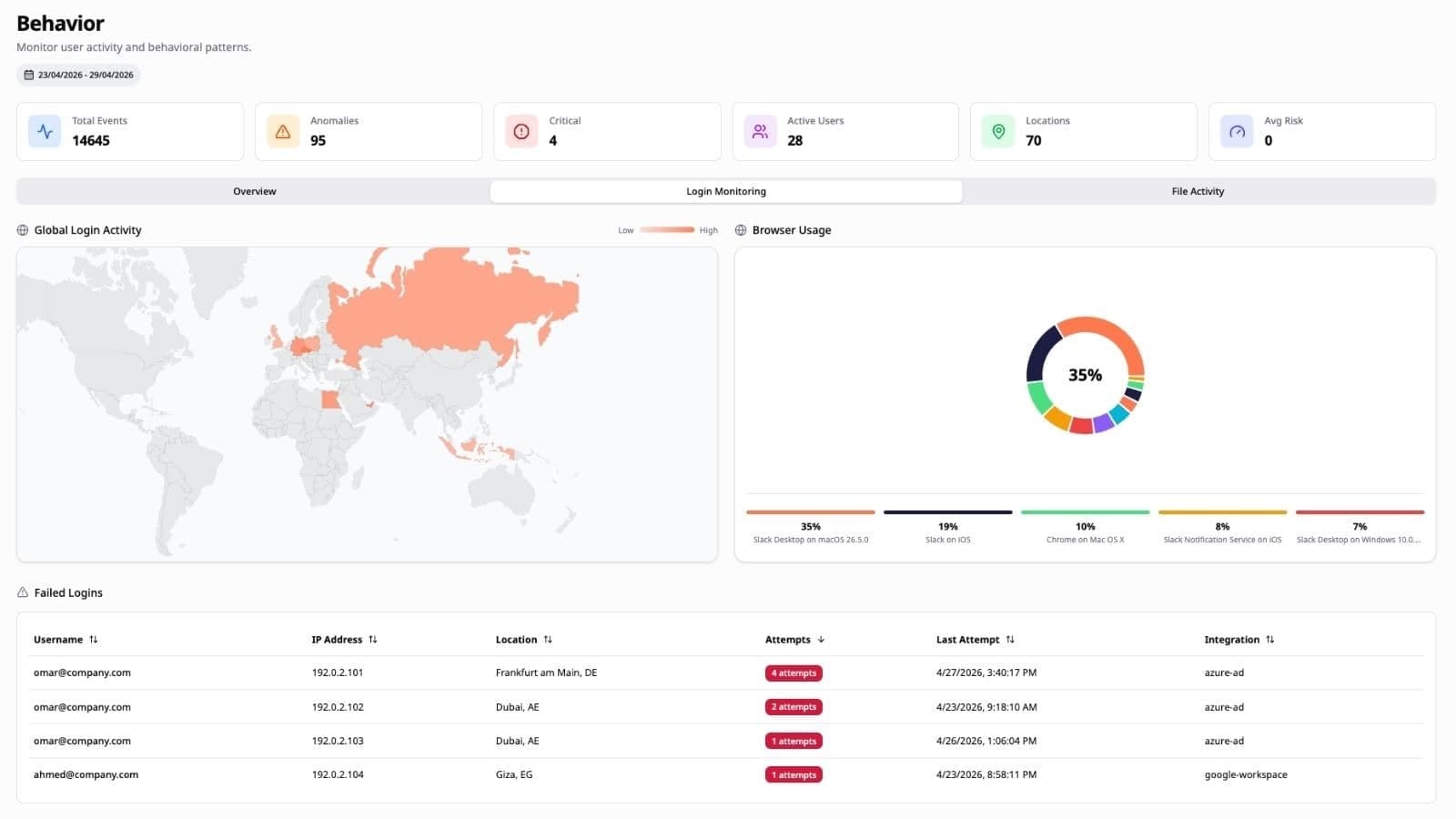
What Pattern of Life Detection Prevents
Credential compromise: Detected within seconds, before lateral movement begins. An off-hours login from a known-compromised credential in an unusual geography doesn't wait for forensics -it's blocked immediately.
Insider threats: Behavior change is surfaced as it's happening. Gradual access expansion, unusual access times, and deviation from role baselines are caught early.
Third-party risk: Vendor accounts compromised? You see the deviation from their rigid, automated pattern within minutes. Revoke access before critical systems are touched.
Lateral movement: Compromised accounts pivoting through the organization are caught as they attempt to access systems outside their baseline scope.
The message is simple: if you're not monitoring identity patterns across all systems simultaneously, you're waiting for detection after breaches have already succeeded.
Pattern of Life Is Identity-First Security
Hackers don't hack networks. They log in. The only defense that works is understanding what normal identity behavior looks like, and then detecting the moment it stops.
Pattern of life security is the baseline for modern breach prevention. If your current stack isn't monitoring identity patterns across all your systems simultaneously, you're operating blind.
What if you could detect the moment a credential is compromised? What if impossible travel attempts, simultaneous logins from different continents, and unauthorized system access all triggered immediate alerts seconds after the attack begins?
That's pattern of life security. That's identity-first defense.
See Pattern of Life Detection in Action
FrontierZero brings unified pattern of life detection to every identity in your organization across SaaS applications, identity providers, VPNs, and corporate systems. Single pane of glass to see everything. Every identity, every login, every access pattern.
Detect anomalies in seconds. Catch breaches in motion, not in forensics.
Schedule a Demo to see how FrontierZero's pattern of life engine prevents breaches before damage occurs.