Why Your Quarterly Identity Reviews Are Already Broken
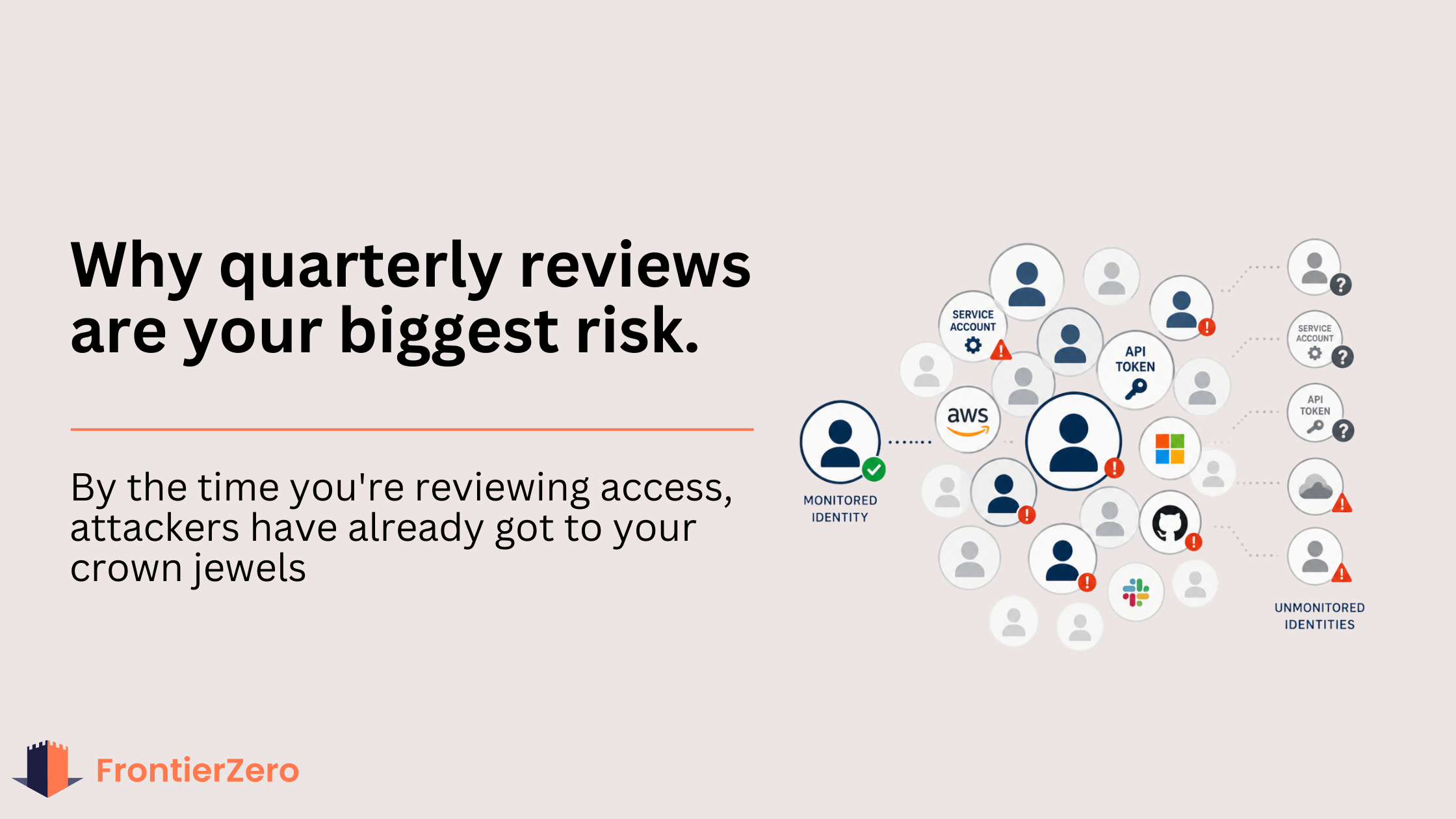
Identity is the attack surface now, yet your governance program is running on a calendar built for 2015.
Most organizations still review access quarterly. Static role models. Manual certifications. Sign-offs that go stale the moment someone approves them. Auditors used to accept this. They asked "did you review access?" Now they ask "can you prove it was appropriate yesterday, today, and tomorrow?"
That's a different burden of evidence. One your quarterly program can't meet.
When an identity gets compromised, attackers move within hours. Your next review is 90 days away. By the time you notice, the attacker has already mapped your blast radius, identified high-value data, and moved laterally. You're not preventing the breach. You're hoping to catch it before the damage becomes expensive.
Three structural forces are making this worse.
Why Quarterly Governance Can't Scale Anymore
Identity sprawl across cloud and SaaS has exploded. Ten years ago, your identity landscape was mostly on-prem, mostly human. Now it's fractured across dozens of cloud platforms, SaaS applications, and hybrid environments you're still discovering.
Service accounts and non-human identities now outnumber human accounts. Often by wide margins. A single microservice might spawn dozens of service identities, each with persistent credentials, each carrying risk you can't manually track.
And regulators stopped accepting "we reviewed it once" as compliance evidence. Auditors want proof. Daily proof. They want audit trails showing real-time monitoring, not just a signature on a spreadsheet from three months ago. They want you to say "here's what this identity was doing on June 15th, and here's exactly why it was appropriate", not "we said it was fine in January."
A quarterly review can't answer that question.
How Identity Compromise Actually Unfolds
The timeline is predictable. An identity gets compromised - stolen credentials, insider threat, supply chain compromise, social engineering.
The attacker tests what it can do. They probe for monitoring. They check for lateral movement opportunities. They learn the blast radius. They move.
All of this happens in hours.
Your governance framework isn't built for that timeline. It's built for quarterly cycles. While you're planning next quarter's access review spreadsheet, the attacker has already been inside, mapped your data, and moved to higher-value targets. You're three months behind from the moment the breach starts.
Three Blindspots Your Program Can't See
Blindspot #1: Service Accounts With No Owner
A microservice gets decommissioned. The project ends. The service gets depreciated.
But the service account? It stays active.
It was certified once as "legacy system, still has dependencies." That certification is now two years old. No one owns it. No one's monitoring it. No one even remembers it exists until it activates on your network at 3 AM, pulling user records it was never meant to touch, querying your customer database.
Your quarterly governance catches this in the next review cycle: 90 days later. By then, the attacker has been inside for weeks. They've exfiltrated data, mapped your architecture, moved laterally through systems this dormant account can reach.
Blindspot #2: Privilege Creep That Looks Legitimate
A user starts with appropriate access for their role. Engineering manager. Write access to production logs. Read access to customer data.
Business needs evolve. Eighteen months pass. One request for elevated permissions in a secondary system. Then write access in another platform. Then administrative access to a third tool. Each request is individually reasonable. Each one fits a legitimate business need. Each one gets approved.
But cumulatively, this person has become a data modification machine. They can alter records, adjust permissions, and cover their tracks across multiple systems.
In quarterly reviews, it looks appropriate. No one sees the trajectory. No one spots the pattern until access is exploited or compliance audits force a forensic recount.
Blindspot #3: Access That Should Have Expired
An employee leaves your organization. Their access should be deprovisioned immediately.
But provisioning is automated. Deprovisioning is manual. Someone's supposed to run a termination request through your identity system. Someone's supposed to remove credentials. Someone's supposed to verify it happened.
Someone forgets.
The account sits active. Dormant, but valid. Three months later, the credentials still work. Someone with those keys, like a former employee, an attacker who stole them, a contractor who borrowed them, still has access to systems they shouldn't touch.
Quarterly governance won't catch this for 90 days. By then, the account has been active and exploitable for months.
What Your Board and Auditors Are Asking Now
The compliance burden shifted. Auditors used to ask, "did you review access this year?" Now they ask "can you prove it was appropriate every single day?"
Insurance companies want the same proof. Regulators want the same evidence. The shift happened quietly, but it's real.
That's not a compliance inconvenience. It's a structural gap that quarterly reviews cannot close.
You need continuous visibility into identity behavior, not annual certifications from three quarters ago. You need audit trails showing real-time monitoring, not just someone's signature on an access review spreadsheet. You need to prove identity governance is happening every day, not just on the one day you ran your review.
Continuous Identity Governance: The Model That Actually Works
Instead of asking "was this access appropriate three months ago," continuous monitoring asks "is this access appropriate right now?"
Watch what every identity is actually doing. Learn what normal behavior looks like for that identity. Act on deviations before they become incidents.
This changes everything:
- Dormant accounts that suddenly activate get flagged immediately, not 90 days later
- Privilege creep gets caught in real time, before it becomes exploitable
- Geographic and behavioral anomalies surface before they become breaches
- Stale access gets deprovisioned on day one, not eventually
- Your certification campaigns stop being exhausting reviews of everything and start focusing on the actual exceptions that carry risk
For a CISO, this pays off three ways:
One: Less breach exposure from identity compromise. Attackers move in hours. If you're watching in real time, you're moving faster than they are.
Two: Compliance evidence that holds up under scrutiny. "Here's real-time proof this identity was appropriate on March 15th, March 16th, and March 17th" is infinitely stronger than "we reviewed it once in January."
Three: Real insight into which identities are drifting highest-risk. You can focus your investigation where it actually matters instead of reviewing thousands of accounts that are fine.
Getting There Takes a Maturity Model
This doesn't happen overnight. You need accurate identity data and usage telemetry in place first. Risk scoring runs continuously on top of what you have. High-risk changes still require human review, this isn't about removing humans from the process, it's about changing what you're asking humans to review.
Security teams that moved first are already catching identity compromise in hours instead of weeks. They're deprovisioning stale identities on day one instead of eventually. They're replacing "we reviewed access once" with "here's real-time proof it's appropriate."
The identities you trust most are the ones you need to watch most carefully. If you're only proving that trust quarterly, you're not actually proving it at all.
Quarterly identity governance isn't a compliance achievement anymore. It's a gap. The ones who wait are the ones explaining, months from now, why access that should have been adjusted was still active. Why the attacker had time to move. Why the breach became expensive.
The ones who move first are already replacing reactive reviews with real-time risk signals.
See how continuous identity governance stops compromise before it spreads