The Best Third-Party Risk Management Tools for GCC Companies in 2026
Third-party breaches are now the leading attack vector in enterprise security. Not phishing. Not ransomware. Third parties.
Verizon's 2025 Data Breach Investigations Report confirmed what GCC CISOs have been sensing for two years: 48% of all breaches now involve a third party, up 60% year-over-year. One in two breaches traces back to a vendor, contractor, integration, or partner your organisation trusted enough to give access.
Here is a list of all the major 2026 third-party breaches.
For GCC organisations, the pressure compounds. UAE PDPL enforcement is active. Saudi Arabia's NCA ECC framework requires documented third-party access controls. DIFC and ADGM regulated entities are being asked to demonstrate continuous monitoring, not just annual vendor reviews.
The market responded with a crowded field of tools all claiming to solve third-party risk. They do not solve the same problem. This guide ranks the five leading platforms, explains what each genuinely does, and helps you understand which problem each one actually solves.
The Core Distinction You Need to Understand
Before comparing products, you need to understand one split in this market: outside-in versus inside-out.
Outside-in tools assess your vendors from your perspective before or at the point of connection. They score external infrastructure, collect questionnaire responses, and record privileged sessions at defined entry points. They are useful. But they have a shared blind spot: they cannot see what your vendors are doing inside your environment after the connection is established.
Inside-out tools monitor the other direction. What are your connected third parties actually doing inside your Microsoft 365, your Salesforce, your Google Workspace right now?
The 2025 and 2026 wave of SaaS supply chain breaches shared one pattern: vendors with legitimate trusted access using that access in ways that deviated from expected behaviour. Every outside-in tool showed those vendors as healthy right up until the breach. The access was trusted. The credentials were legitimate. The breach happened entirely from within.
That context shapes this entire comparison.
1. FrontierZero Inside-out SaaS security and third-party monitoring
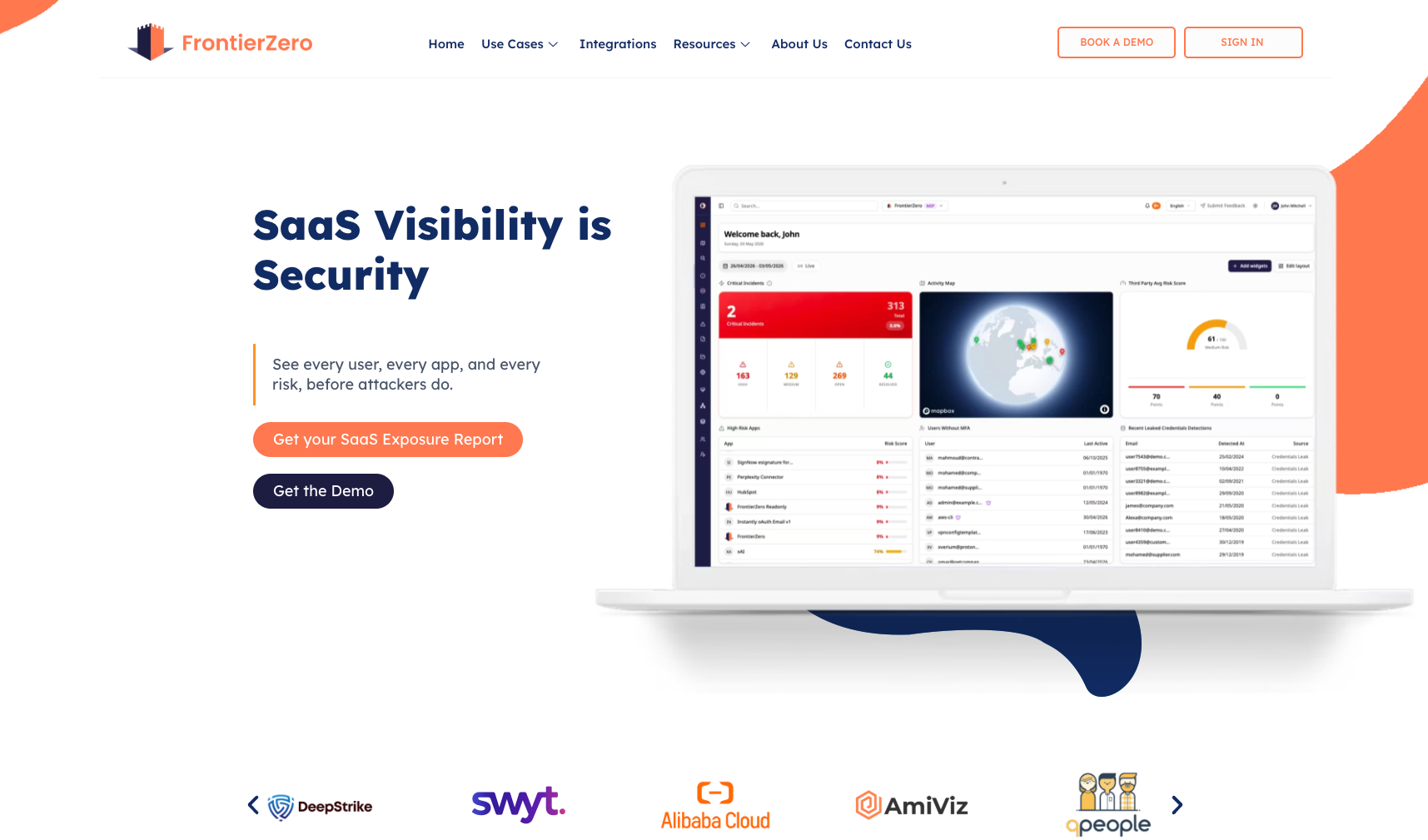
FrontierZero is the only platform on this list built to answer the question every other tool leaves open: what are your connected third parties doing inside your environment right now?
While SecurityScorecard scores your vendors' external infrastructure and OneTrust documents what they say about their security, FrontierZero monitors what they actually do post-connection. Real-time inventory of every third-party application connected to your SaaS environment, exact OAuth scopes and permission sets mapped against each vendor's stated function, continuous behavioural monitoring that flags deviations from baseline, shadow AI and unapproved integration detection, and access sprawl identification when connected applications accumulate permissions beyond their original scope.
For GCC compliance, FrontierZero generates documented evidence of continuous third-party monitoring for PDPL, NCA ECC, and DIFC audits, going beyond what point-in-time questionnaires can provide.
Choose FrontierZero if: You want to know what your vendors are doing inside your environment today. You have a SaaS-heavy stack with dozens of connected integrations and no clear picture of what permissions they hold. Your security team is lean and cannot manually audit every third-party connection. You already have a cyber ratings platform or questionnaire tool and want to close the gap between "we assessed this vendor" and "we know what this vendor is doing right now." You need continuous monitoring evidence for a PDPL, NCA ECC, or DIFC audit, not just an annual questionnaire cycle.
The honest limit: FrontierZero does not replace a vendor portfolio scoring tool if you are managing hundreds of procurement-stage vendor relationships. For that outside-in layer, pair it with SecurityScorecard or BitSight.
2. SecurityScorecard External vendor portfolio scoring
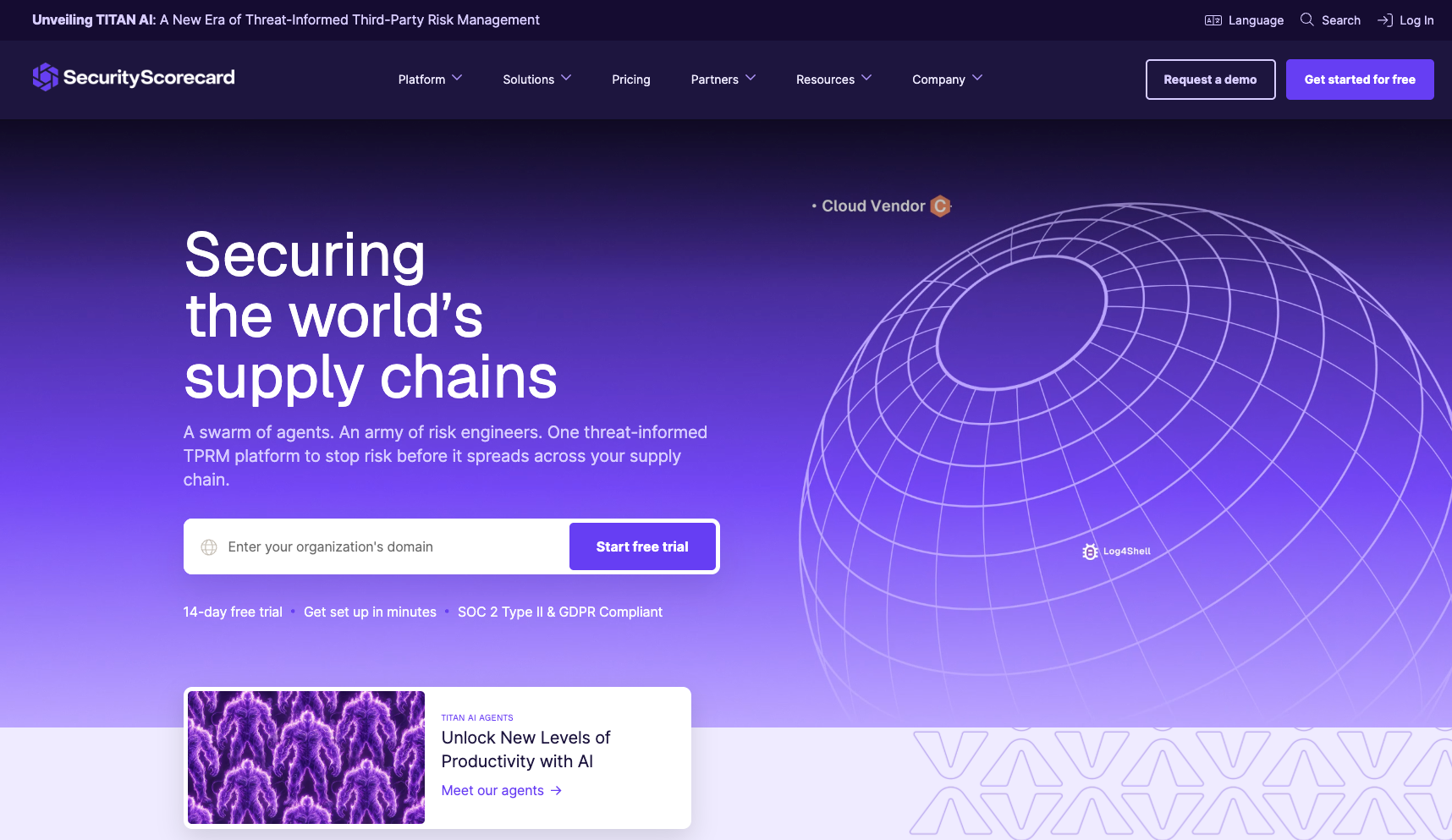
SecurityScorecard continuously monitors your vendors' external infrastructure and translates findings into a letter grade across ten risk factors: DNS health, network security, application security, leaked credentials on the dark web, and more. A risk team of three can maintain portfolio-level visibility across 500 vendors without manual investigation of each one.
Choose SecurityScorecard if: Your primary challenge is managing a large vendor register and making procurement decisions at scale. You need board-ready risk reports showing vendor security posture across your supply chain. You have no current visibility into your vendor portfolio at all and need to establish that foundation first. For NCA ECC and UAE PDPL audits, SecurityScorecard produces clean documented evidence of third-party portfolio monitoring.
The limit: SecurityScorecard measures what your vendors look like from the outside. A vendor can maintain an A score while a connected application is exfiltrating data from your Salesforce org. The score and the breach exist in entirely different planes. Once a vendor is connected to your environment, SecurityScorecard's visibility ends.
3. BitSight External vendor scoring for regulated financial institutions
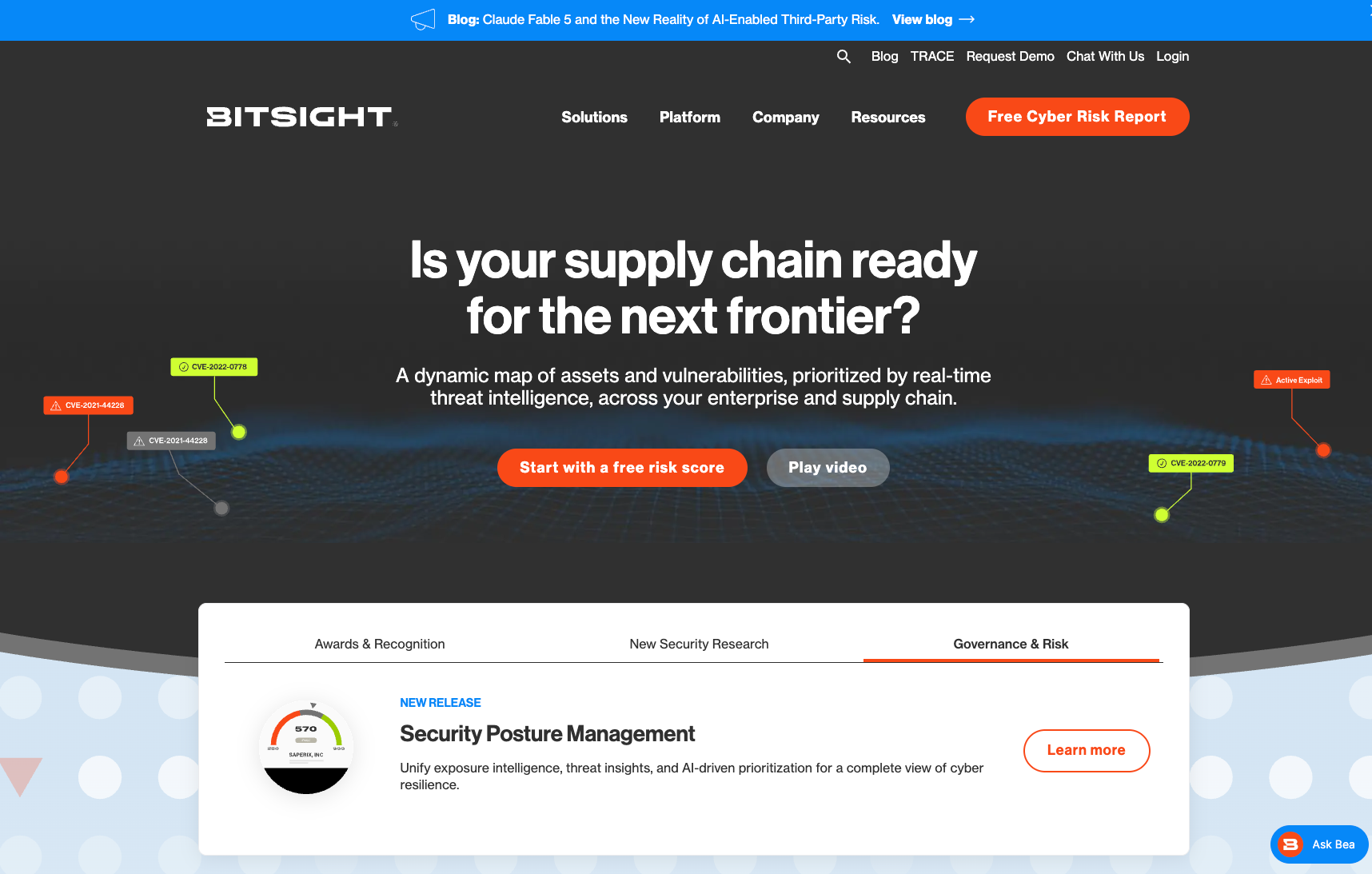
BitSight pioneered the cyber ratings category and remains the market leader in financial services. Its scoring model aggregates signals from a global sensor network and includes stronger regulatory framework alignment and peer benchmarking than most competitors, letting you compare a vendor's score against their industry cohort.
Choose BitSight if: You are a regulated financial institution under UAE Central Bank, SAMA, or DIFC oversight where BitSight has recognised credibility with examiners. You need to benchmark vendor scores against sector peers as part of your risk decision process. Your GRC platform already integrates with BitSight's data feeds. For procurement-stage decisions and board-level reporting in banking and insurance, BitSight is the stronger choice in the cyber ratings category.
The limit: Same fundamental constraint as SecurityScorecard. Outside-in only. The 2025 supply chain breaches that hit enterprises with strong BitSight scores on their vendors made this limitation visible at scale. What happens inside your environment after vendor onboarding is outside BitSight's scope entirely.
4. OneTrust Vendorpedia Vendor questionnaire and compliance documentation
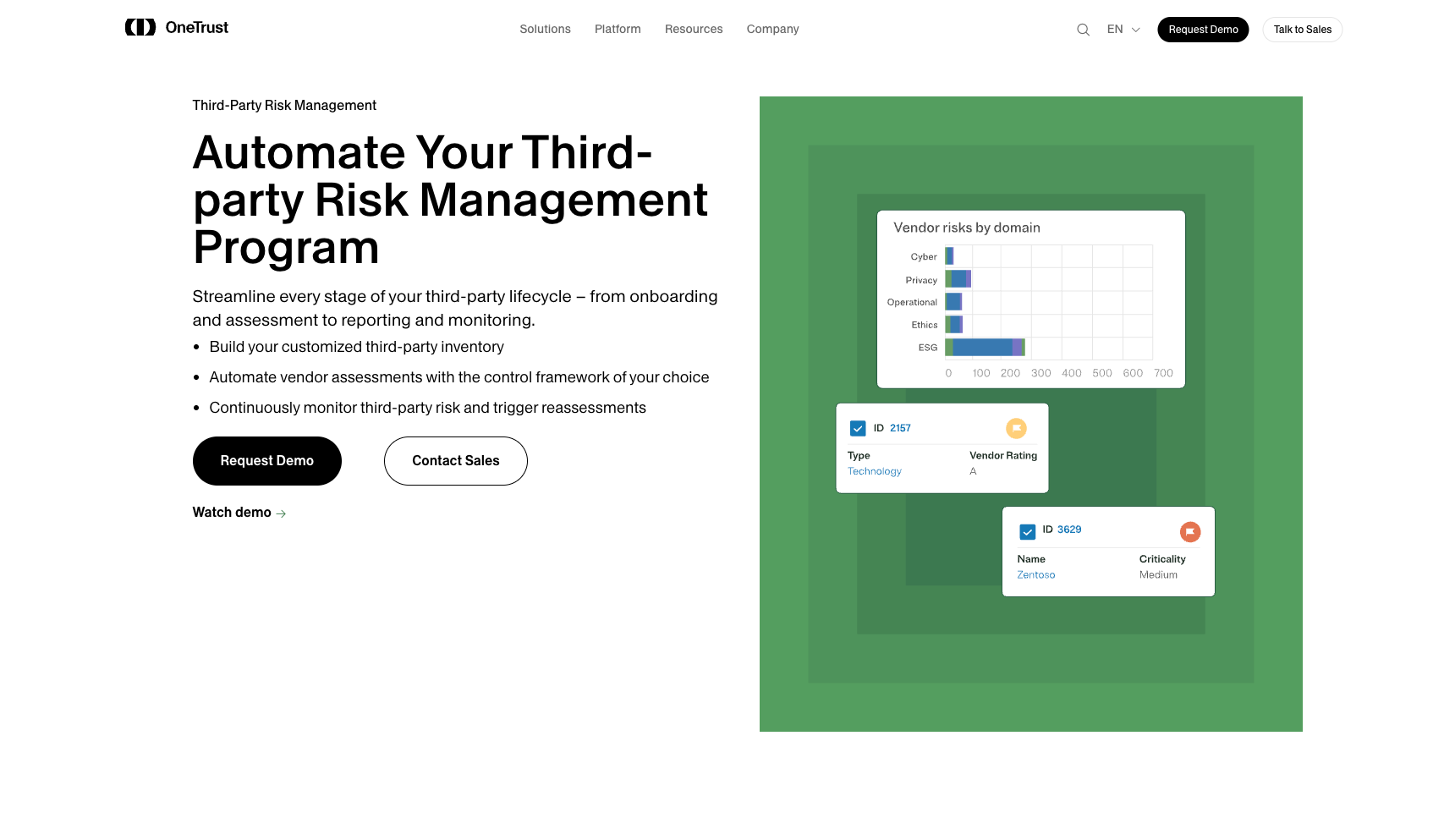
OneTrust Vendorpedia automates the vendor due diligence lifecycle: sending questionnaires, collecting responses, storing certifications, tracking remediation, and generating audit evidence. It replaces spreadsheet-based vendor assessment processes with a documented trail regulators expect to see.
Choose OneTrust Vendorpedia if: Your most urgent problem is regulatory audit readiness. You need to demonstrate to a PDPL, NCA ECC, or DIFC examiner that you have assessed your vendors, documented the results, and tracked remediation. You are building a third-party risk programme from scratch and need to get suppliers assessed before a compliance deadline. You require a platform that connects vendor risk data into a broader privacy and data governance programme.
The limit: Questionnaires are self-reported with no validation layer. A vendor answers "yes" to every control, and the platform records it as compliant. What their connected applications are doing inside your environment is entirely outside OneTrust's scope. The LastPass breach is the clearest example: mature documented controls, completed certifications, a specific compromised engineer's device giving attackers access. No questionnaire would have caught it.
5. CyberArk Privileged access management for contractor sessions
CyberArk controls and audits privileged access for third parties. Just-in-time provisioning, session recording, credential vaulting, time-limited access workflows. Contractors never see actual credentials; CyberArk injects them and records every action during the session.
Choose CyberArk if: Your third-party risk is concentrated in human contractors who need direct, privileged, interactive access to critical systems. A systems integrator maintaining your ERP. A network vendor accessing your firewall. A managed security provider operating in your SOC. Any environment where a third-party human needs to do something directly in your infrastructure and that session needs to be auditable. CyberArk owns this use case.
The limit: CyberArk is built for a specific access model: a human who authenticates, acts, and logs out. Most modern third-party access does not work this way. Your CRM integration, your marketing automation platform, your AI tools, none of these create a CyberArk session. They connect via OAuth, establish persistent trusted relationships, and operate continuously in the layer CyberArk cannot see.
6. Netskope Cloud access security and outbound data loss prevention
Netskope proxies or monitors traffic between your users and cloud services, providing shadow IT discovery, DLP enforcement on cloud traffic, and anomalous user behaviour detection. Typically deployed as part of a broader SASE architecture.
Choose Netskope if: Your primary concern is what your own employees are doing with cloud tools. Shadow IT proliferation, outbound data leakage, and unapproved application usage by your workforce are Netskope's core strengths. If you are building a Zero Trust architecture and need SSE capabilities, Netskope belongs in that stack. It is the right choice when your security concern is employee behaviour rather than vendor behaviour.
The limit: Netskope is outbound and user-centric. When a vendor application already OAuth-connected to your Microsoft 365 accesses your data, that does not pass through Netskope. The vendor is not a user in your identity system. The connection was pre-authorised. What that application does with that access, and whether it stays within expected parameters, is invisible to Netskope.
Side-by-Side Comparison
How to Choose
If you want outside-in vendor scoring at scale: SecurityScorecard or BitSight. Choose BitSight if you are a regulated financial institution where examiner credibility matters. Choose SecurityScorecard if you need broader portfolio coverage at lower cost.
If you need compliance documentation for a regulatory audit: OneTrust Vendorpedia. Get the questionnaire layer in place. Know that it documents what vendors say, not what they do.
If contractors have direct privileged access to critical systems: CyberArk. Own the session layer properly.
If your employees are connecting shadow tools and your outbound visibility is limited: Netskope. Fix the outbound gap.
If you want to know what your connected vendors are doing inside your environment right now: FrontierZero. This is the layer every other tool on this list leaves open.
Most mature GCC security programmes need more than one layer. The outside-in tools are necessary. But if you have vendor scores and questionnaires and nothing monitoring post-connection behaviour, your blind spot is exactly where attackers are operating.
Frequently Asked Questions
Do I need FrontierZero if I already have SecurityScorecard or BitSight?
Yes, and they serve different purposes. Cyber ratings tell you what your vendors look like from the outside before and during onboarding. FrontierZero tells you what they are doing inside your environment after they are connected. Most GCC enterprises that get breached through third parties had healthy vendor scores. The breach happened in the layer the score cannot see.
Is a vendor questionnaire enough for NCA ECC or UAE PDPL compliance?
Questionnaires satisfy the documented assessment requirement. But regulators are increasingly asking for continuous monitoring evidence, not just point-in-time reviews. FrontierZero generates that continuous evidence. A questionnaire tells an auditor you asked the right questions. FrontierZero tells them you are watching what happens after.
What is the difference between what Netskope sees and what FrontierZero sees?
Netskope monitors your employees going out to cloud services. FrontierZero monitors your vendors coming in to your SaaS environment. They watch opposite directions. A company with both covers its employees' shadow IT and its vendors' post-connection behaviour. Without FrontierZero, the inbound vendor layer is unmonitored regardless of what your CASB sees.
Can CyberArk cover the same risk as FrontierZero?
No. CyberArk covers privileged human sessions at defined access points. FrontierZero covers SaaS-to-SaaS connections established via OAuth and API, which bypass CyberArk entirely. Most current third-party breaches happen through the OAuth layer, not through privileged human sessions. The tools are complementary, not overlapping.
How quickly can FrontierZero give us visibility into our current third-party connections?
FrontierZero connects to your SaaS environment and maps all existing third-party connections, permission sets, and access patterns within the first session. Most organisations discover connected applications and OAuth scopes they were unaware of during the initial setup.