Oxford University Suffered Two Third-Party Data Breaches in One Term. Here Is What Actually Happened.
Oxford's own systems held. Their vendors didn't. Two third-party breaches in one academic term, and no independent detection capability in either case. A full technical breakdown.
Oxford University did not get hacked. Its vendors did so twice, within the same academic term, exposing the personal data of students, alumni, research staff, and recruiters across multiple institutions.
That distinction is doing a lot of work in the headlines. But for any CISO trying to explain third-party risk to a board, or any security leader building a vendor risk programme, the Oxford incidents are a near-perfect case study in how modern breaches actually unfold.
Here is a detailed breakdown of what happened, what the technical gaps were, and what it means for your own environment.
The Two Incidents: A Timeline

Breach 1 Instructure Canvas (May 2026)
In early May 2026, Oxford was among approximately 8,809 educational institutions globally affected by a breach at Instructure, the company behind the Canvas learning management system (LMS). The attack was claimed by the ShinyHunters extortion group, the same threat actor behind breaches at Ticketmaster, Santander, and AT&T in 2024.
The Canvas breach exposed usernames, email addresses, student ID numbers, course enrollment data, and private messages. Instructure subsequently confirmed receiving digital confirmation of data deletion (shred logs) and stated that no customers would be extorted as a result. The incident nonetheless disrupted learning activities across multiple countries during exam season, a timing that appears deliberate.
Oxford temporarily disabled access to Canvas while Instructure worked to contain the breach.
Breach 2 — Group GTI / CareerConnect (May 28, 2026)
Before the Canvas situation was fully resolved, a second and entirely separate breach hit Oxford's career services platform, CareerConnect, operated by London-based third-party provider Group GTI via their TargetConnect product.
On May 28, unauthorized access to GTI's infrastructure exposed:
- Full names and email addresses of students, alumni, research staff, and recruiters
- Encrypted passwords for any user who did not authenticate via Single Sign-On (SSO)
Oxford was notified by GTI on June 1 and issued public communication to affected users on June 4, a seven-day gap from the breach date that may attract scrutiny from the UK Information Commissioner's Office (ICO) under UK GDPR's 72-hour controller notification requirement.
Importantly: Oxford's own systems, student passwords stored by Oxford IT, financial records, uploaded documents, appointment data, and academic information were not affected. The breach was entirely contained within GTI's infrastructure.
Who Was Affected
The scope of the CareerConnect breach extended beyond Oxford alone.
CareerConnect / TargetConnect is a shared platform also deployed by King's College London and the University of Manchester, among others. If the vulnerability existed at the platform level rather than in Oxford's specific configuration, users at other UK institutions may have been exposed during the same window. At time of publication, no other university had issued a formal statement.
For Oxford specifically, the affected population included:
- Alumni with direct CareerConnect credentials (not SSO): names, emails, and encrypted passwords
- Research staff with direct-login accounts had the same exposure profile
- Employer/recruiter accounts had the same exposure profile
- Students using SSO names and email addresses only (passwords not stored by GTI)
GTI invalidated all affected passwords immediately and required users to reset credentials at next login. Oxford confirmed it was awaiting further information from GTI on the precise number of affected accounts.
The Attack Vector: Credential Harvesting for Downstream Phishing
GTI indicated the breach appeared to be focused on gathering credentials to enable phishing attempts rather than data destruction or ransomware deployment.
This matters for two reasons.
First, it explains why the breach was not immediately obvious. The attacker's goal was to move quietly, extract credentials, and leave. The kind of low-and-slow activity that periodic external vendor assessments are structurally incapable of detecting in real time.
Second, it compounds the risk from the Canvas breach. Oxford users now face layered phishing exposure from two simultaneous credential events in the same term: Canvas-sourced usernames and enrollment data combined with GTI-sourced email addresses and encrypted passwords. For any user who reused credentials, the risk profile is significantly elevated.
Why Oxford's Own Security Team Bears No Blame
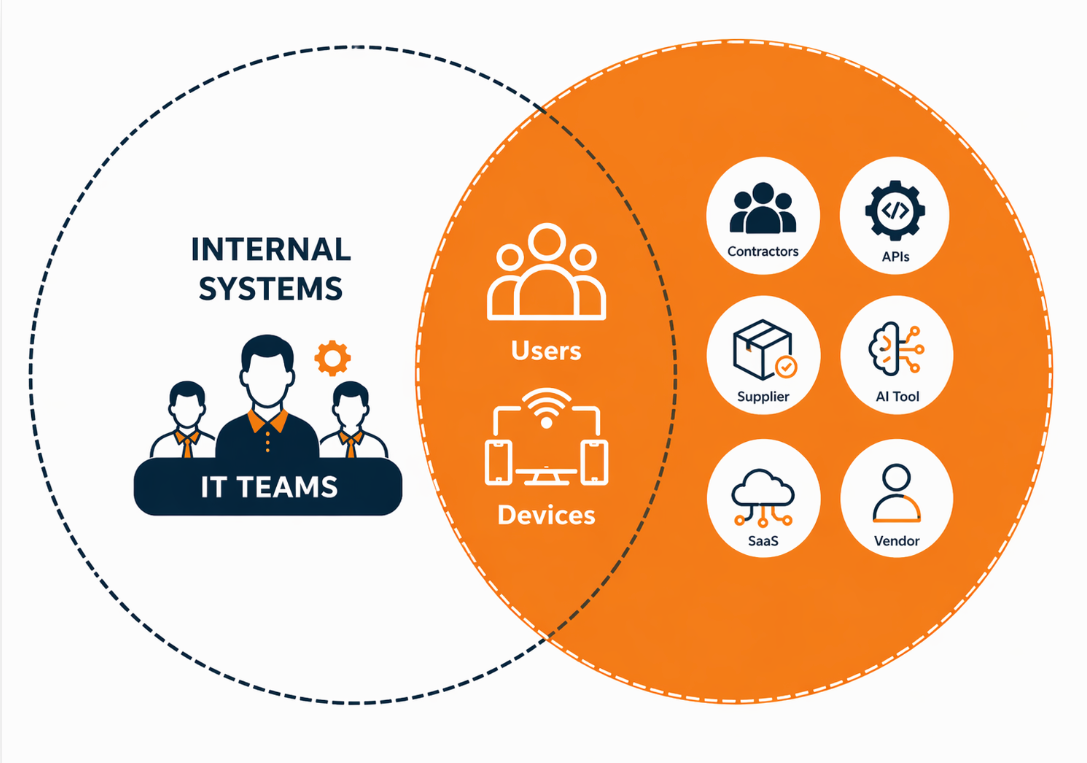
Oxford confirmed there is no indication that University systems were compromised in either incident. Internal infrastructure held. The security team did not fail in any conventional sense.
What failed was the perimeter model of vendor risk management: assess once, trust continuously.
GTI passed whatever due diligence Oxford had in place. They were a contracted, trusted platform provider. Their credentials were legitimate. Their access was authorized. From the outside, they looked clean because external scoring tools assess attack surface, known vulnerabilities, and reputation signals. What they cannot tell you is what a vendor's platform is doing with your users' data at 2 am on a Tuesday.
The detection lag is the clearest evidence of this gap. Oxford was dependent entirely on GTI to discover the breach and report it. They had no independent line of sight into their vendor's environment. By the time they knew, the data was already gone.
The Technical Gaps This Exposes
The Oxford incidents surface three specific security control failures worth examining in any enterprise environment:
1. No continuous visibility into third-party SaaS environments
Oxford had authorized GTI to hold user data. They did not have a mechanism to independently monitor what GTI's platform was doing with that data. This is not an Oxford-specific failure; it is the default state for most organizations managing vendor relationships through periodic assessments, contract reviews, and SOC 2 reports.
2. Inconsistent SSO adoption across vendor platforms
Users who authenticated through Oxford's SSO had their passwords protected. Those who maintained local credentials within CareerConnect did not. The security gap between these two groups was not a breach response failure. It was a configuration decision made at deployment. Enforcing SSO at the vendor integration level, rather than leaving it as a user choice, is an identity lifecycle control that would have materially reduced the blast radius here.
3. Detection lag as regulatory exposure
The seven-day gap between the May 28 breach and June 4 user notification is the kind of timeline that invites ICO scrutiny. UK GDPR requires data controllers to notify the ICO within 72 hours of becoming aware of a breach, and "becoming aware" is defined from the moment the controller has sufficient certainty, not from when the vendor chooses to disclose. When your breach detection depends on your vendor's own incident response processes, your regulatory clock starts on their schedule.
What This Means Beyond Higher Education

Universities are attractive third-party breach targets for obvious reasons: large user populations, significant PII volumes, multiple SaaS integrations maintained outside central IT visibility, and, in many cases, less mature vendor governance than financial services or critical infrastructure.
But the structural failure here is not sector-specific.
Any organization that relies on third-party SaaS platforms to deliver services to end users faces the same core exposure: the data lives outside your perimeter, but the regulatory and reputational liability lives with you.
The questions any CISO should be asking their SaaS vendors after reading the Oxford incidents:
- What is your breach detection capability, and how is it monitored?
- How quickly will you notify us of a security event, and what is your SLA?
- What password hashing algorithm do you use for locally stored credentials?
- Can SSO be enforced for all user types, not just certain account categories?
- Is your platform shared infrastructure serving multiple clients, and how is data isolated between tenants?
These are not due diligence questions to ask once at contract signing. They are operational questions that require ongoing, real-time answers.
The Pattern Worth Paying Attention To
Two breaches. One term. One institution. Neither originating inside Oxford's own systems.
This is not bad luck. It is the predictable outcome of a vendor risk model built on point-in-time assessment and continuous trust. Attackers are not trying to breach the university; they are trying to breach the vendors that the organization trusts, because those vendors hold the same data with less scrutiny on their security posture.
The Canvas breach demonstrated how a single compromised LMS provider can expose nearly 9,000 institutions simultaneously. The GTI breach demonstrated how a shared career platform can expose multiple elite universities through a single vulnerability. In both cases, the institutions that held the regulatory and reputational liability had no independent detection capability.
That is not an edge case. That is the operating model for third-party risk at scale.
What Continuous Third-Party Visibility Looks Like in Practice
The gap exposed at Oxford is not primarily an assessment gap. Oxford assessed GTI. GTI was approved. The gap is a detection gap: the absence of real-time visibility into what authorized third-party platforms are doing inside your environment.
Continuous third-party visibility means knowing:
- Which vendors have active SaaS access right now, and to what data
- Whether that access has been reviewed and is still necessary
- When access patterns change in ways that indicate a potential compromise
- Whether your identity controls (SSO enforcement, MFA, access scoping) are applied consistently across every vendor integration
This is the difference between knowing what a vendor looked like at assessment time and knowing what they are doing today.
FrontierZero is built to close this gap, not by replacing vendor assessments, but by adding the continuous visibility layer that tells you what is actually happening within your third-party SaaS environment in real time.
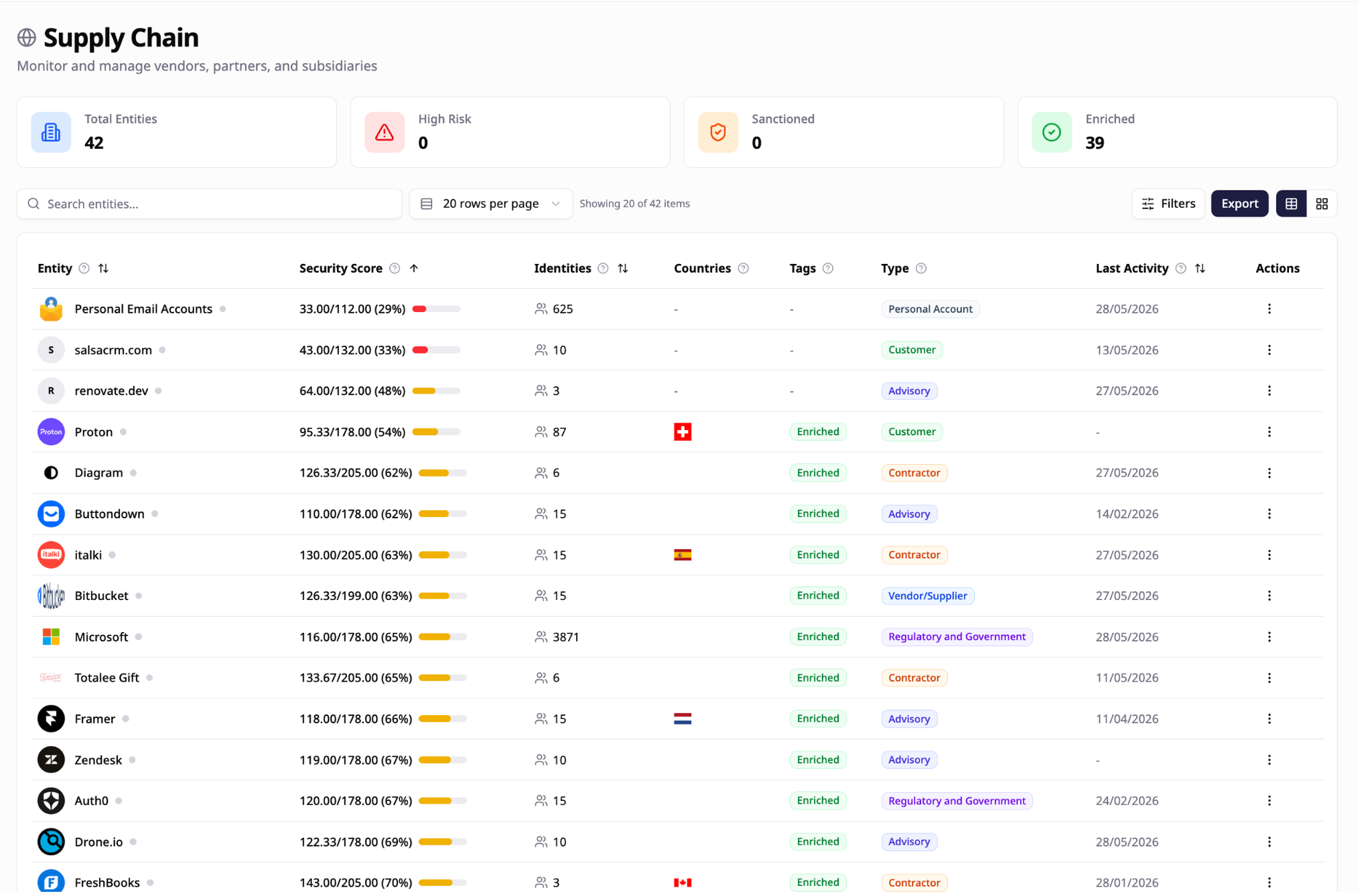
Start with your External Connections Report. Free, agentless, and available here