What Is CUEBA? Pattern of Life Security for Contractors and External Connections
For years, identity security has rested on one quiet assumption: the people logging into your systems work for you.
That assumption no longer holds. Contractors, MSPs, vendors and partners log into your SaaS apps, ERPs and file shares every day, often with more privilege than your own staff.
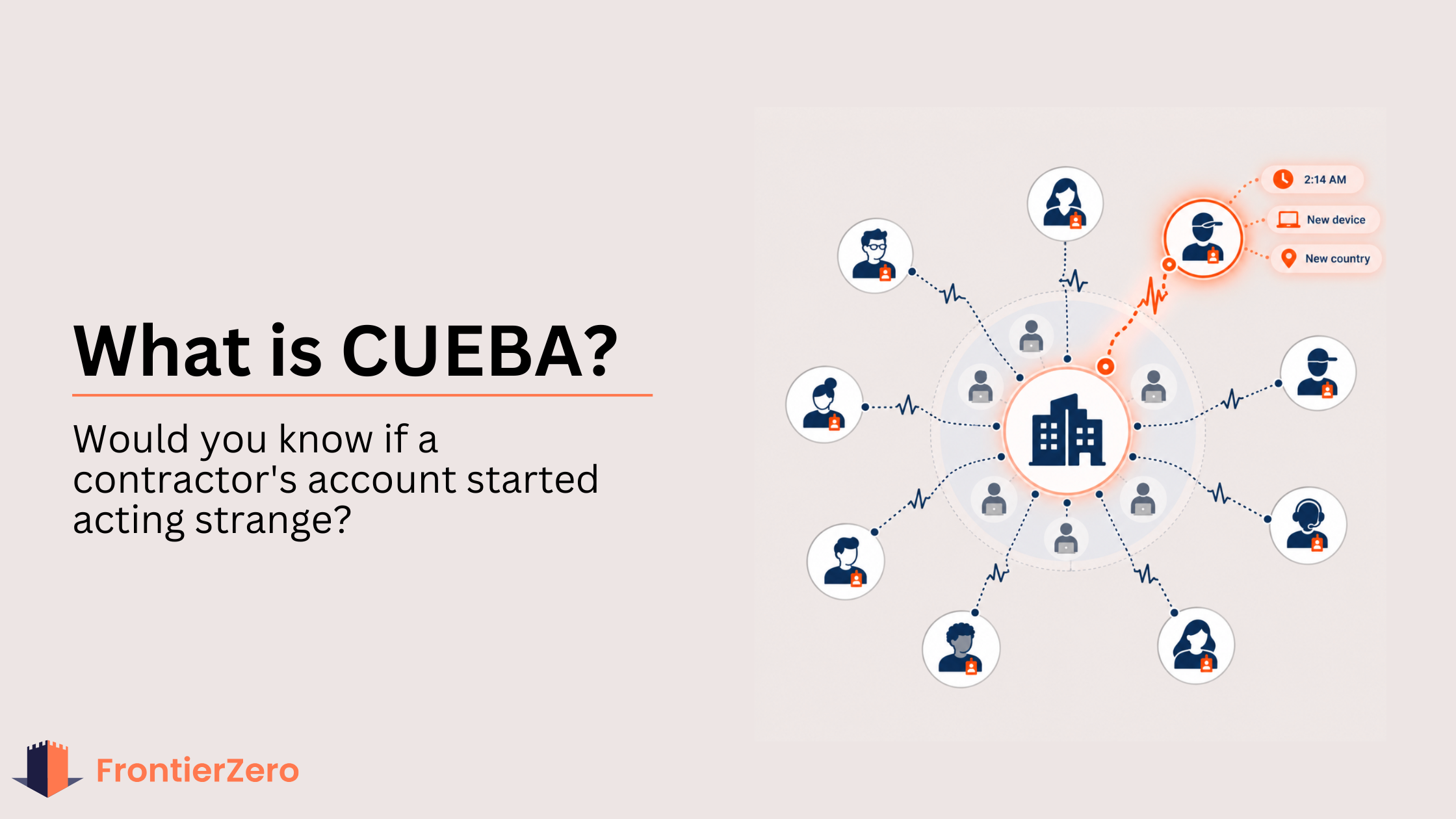
UEBA changed how security teams watch employees. CUEBA, Contractor User and Entity Behaviour Analytics, is the next step: behaviour analytics for every external identity you let in.
It's a new category. This post explains what CUEBA is, why it matters now, how it works through pattern of life, and the questions security teams ask before adopting it.
The short version? Hackers don't hack. They log in. Increasingly, through someone else's account.
What is CUEBA? UEBA for the people you didn't hire
You already know UEBA. It answers one question well: is this employee behaving like themselves?
But UEBA builds its baselines from HR and directory data: department, title, manager, peer group. External identities break that model. They often sit outside your identity provider, have no peer group, log in irregularly by design, and outlive the contracts that created them.
CUEBA, Contractor User and Entity Behaviour Analytics, closes that gap. It continuously compares every external identity against its own baseline, across every system it can reach.
UEBA watches the people you hired. CUEBA watches the people you let in.
At its core is the idea we've built FrontierZero around: pattern of life. Every identity, human or not, employee or contractor, has a rhythm. When it logs in, from where, on what, and what it does once inside. Learn the rhythm, and the moment it breaks becomes visible.
Why it matters now
To see why this category needs to exist, picture a Monday that starts like any other.
Your SIEM is quiet. Endpoint coverage is green. MFA rollout hit 98% last quarter. You did the work.
At 7:42 AM, an email hits your inbox.
A ransomware group has posted your customer data on a leak site. Legal is already on the call. The board wants answers by noon.
By Wednesday, forensics finds the entry point. It wasn't a zero-day. It wasn't malware on a laptop you manage. It was a login.
A support account belonging to an outsourced IT provider. Their engineer's password had been stolen by infostealer malware on a machine you never knew existed. The account had sat dormant for seven months. Then, one Saturday at 2 AM, it woke up, from a new country, on a new device, and spent three hours walking through your CRM and file shares.
Every one of those logins was valid. Every one was logged. Not one of them was seen.
And on Wednesday afternoon, someone in the boardroom asks the question you knew was coming:
"How did security miss this?"
This scenario is fictional. The pattern is not. It is how a growing share of breaches now unfold.
This isn't hypothetical. It's the pattern.

In Verizon's 2026 DBIR, third parties were involved in 48% of breaches, up from 30% a year earlier (summary). Nearly one in two.
Two stories show what that looks like in real life.
Jaguar Land Rover: the key nobody changed. In March 2025, the Hellcat group leaked around 700 internal JLR documents. The way in was a Jira login belonging to an LG Electronics employee with third-party access, stolen by infostealer malware and reportedly dating back to 2021. A supplier's credential, years old, still opened the door.
Qantas: the trusted connection. In July 2025, attackers targeted a Qantas contact centre and reached a third-party customer platform, later identified as Salesforce. Qantas confirmed 5.7 million unique customers had data in the compromised system. The route in was legitimate. The behaviour wasn't.
Both organisations had serious security programmes. Neither breach needed an exploit. Both ran through access that looked normal on the surface.
We track these cases as they happen in our list of 2026 third-party and external connection breaches. Scroll through it and the same sentence keeps repeating: valid credentials, external access, nobody watching the behaviour.
Would you notice?
Here's a simple test. Imagine one of your external connections starts behaving strangely tonight.
- Would you notice if a vendor account, silent for six months, logged in at 2 AM from a new country?
- Would you notice if a contractor's MFA factor changed, or a new device appeared on their account?
- Would you notice if an MSP engineer started opening apps they have never touched before?
- Would you notice if a partner's account exported ten times its normal volume of data?
- Would you notice if a consultant logged in after their contract had ended?
If your honest answer is "probably not", you're far from alone, and it isn't a reflection of your team. It's a reflection of your tooling. Those questions can't be answered by a tool that was never pointed at those identities.
It was never a skills problem
Let's be clear about something most vendors won't say: the security team in that story didn't fail.
They watched everything they were given the tools to watch. Firewalls. Endpoints. Employee identities. They did it well.
The problem is what sits outside that view. Contractors, MSPs, vendors, and partners log into your systems every day. Many use guest accounts, local app logins, or credentials managed by someone else. Most never show up in the dashboards your team lives in.
You were handed a map with a hole in it. Then asked to guarantee nothing comes through the hole.
That's the uncomfortable truth of modern security. Accountability scaled with your attack surface. Visibility didn't.
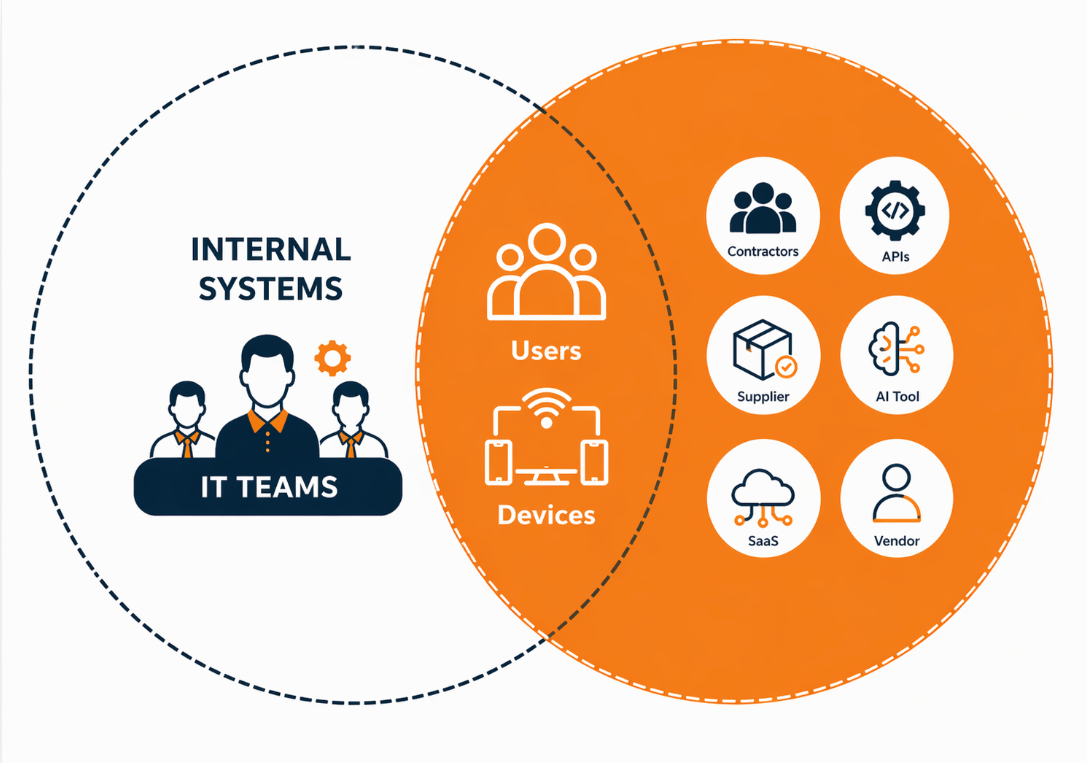
And attackers have noticed. Hackers don't hack. They log in. Not through your hardened front door, but through the side door you handed to a supplier, using a key that looks perfectly legitimate to every tool you own.
How CUEBA works with FrontierZero
FrontierZero is the only company in the world bringing pattern of life security to your contractors and external connections, not just your employees.
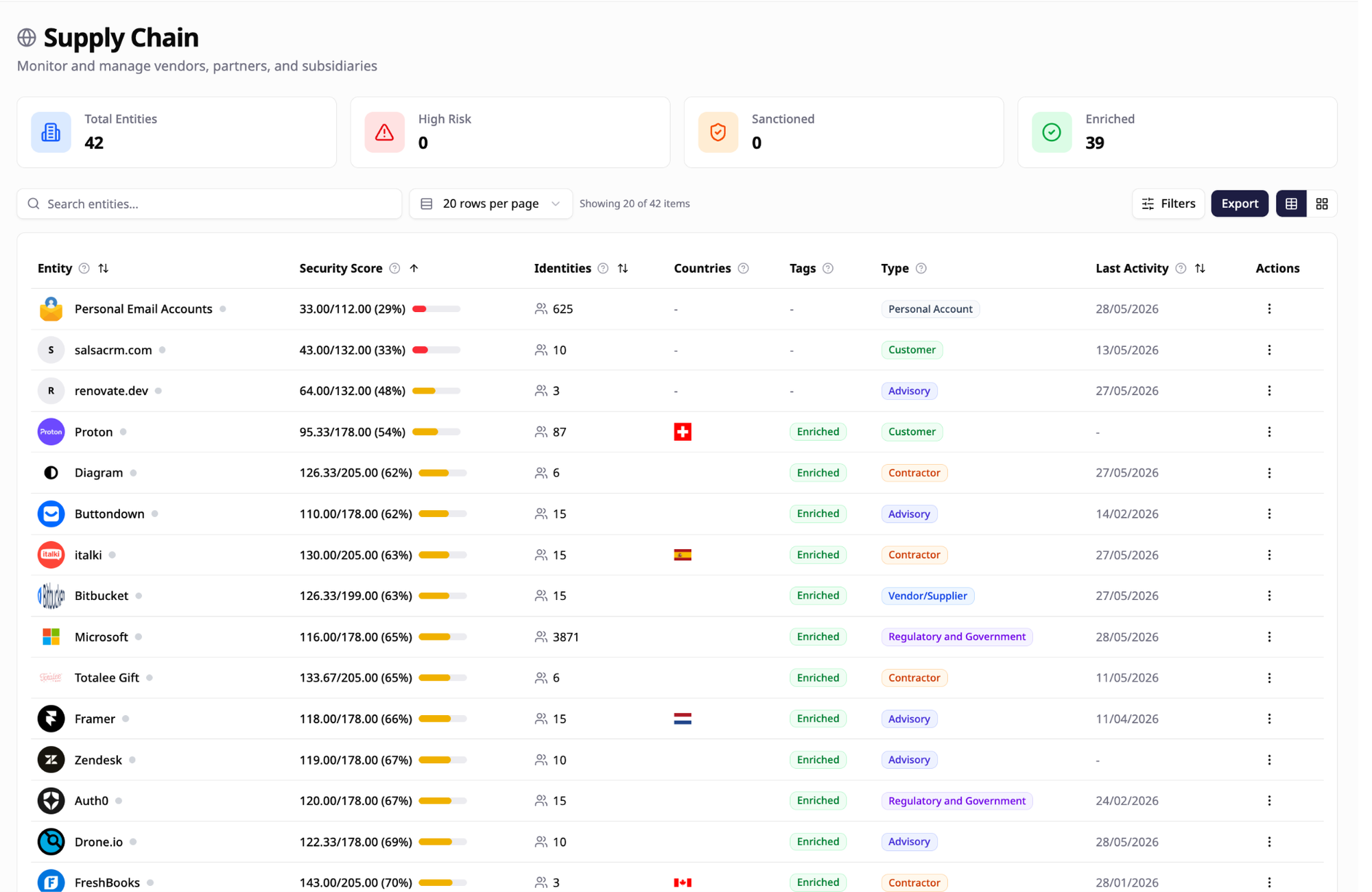
We give you an inside-out view: not what a vendor says about itself in a questionnaire, but what its people actually do inside your systems. All in a single pane of glass.
For every contractor, vendor, MSP and partner account, you see:
- Activity: when they log in, how often, from where, on which devices and networks. Their real working rhythm.
- Actions: which apps they open, what they access, what they change, and how much data they move.
- MFA and authentication: whether MFA is enforced, when factors change, failed attempts, and new devices on the account.
- Risk: a live risk picture per identity, combining privileges, dormancy, leaked credentials from our dark web monitoring, and behavioural drift.
- Lifecycle: which accounts are dormant, orphaned, or still active after the engagement ended.
Then we connect the dots. Logins from your SaaS apps, identity providers and VPNs are stitched into one timeline per identity, so a pattern break in one app is read alongside what that identity is doing everywhere else.
Now replay Monday morning
Same outsourced IT account. Same stolen password. Same Saturday, 2 AM.
This time, FrontierZero already knows that account's pattern of life. It knows the account has been silent for seven months. It knows the credential appeared in an infostealer log. It knows the login is from a country and device it has never seen. And it sees the account heading straight for the CRM, an app it has never opened.
Four signals. One identity. One alert, with the full story attached. Your team forces a logout and revokes the account before the first file leaves.
On Monday at 7:42 AM, nobody sends an email. Instead, you walk into the leadership meeting with a different story: "We caught a compromised vendor account on Saturday night and shut it down."
That's the difference between being blamed for a breach and being credited for stopping one. Visibility is Security.
The questions you're probably asking
You've heard plenty of vendor promises. Healthy skepticism is part of the job. Here are the questions we hear most from security leaders, answered straight.
"Isn't this just UEBA with a new name?" No. UEBA compares people to peer groups built from your HR data. Contractors have no HR record and no peer group. CUEBA baselines each external identity against itself, which is the only fair comparison for someone who logs in twice a month by design.
"Our IdP and SIEM already log contractor activity." Logging isn't watching. Many external accounts never pass through your IdP at all: local app logins, vendor-managed credentials, shared accounts. And the logs that do exist sit scattered across apps, with no baseline telling you what's abnormal. A log nobody reads until after the breach is evidence, not detection.
"Won't this just flood my team with more alerts?" The opposite is the goal. One odd login on its own is noise, and we treat it that way. CUEBA alerts when signals converge on one identity, and hands you the full timeline, so your analysts investigate one story instead of chasing four disconnected events.
"We already run third-party risk assessments." Keep running them. TPRM tells you whether a supplier should be trusted. CUEBA tells you whether the person logged in with that supplier's credentials is behaving like someone you trust. Breaches happen in the space between those two questions.
"Do I have to replace what I already have?" No. CUEBA adds the layer your stack is missing. It works alongside your IdP, SIEM and TPRM programme and makes each of them more useful, because it finally covers the identities they weren't designed to see.
See it in action
We walk through CUEBA and the pattern of life of an external identity in a short video. Watch it on LinkedIn, and follow our page while you're there for weekly breach breakdowns.
So, would you notice?
You can't protect what you can't see. And you shouldn't be blamed for what you were never given the means to see.
Start by mapping it. Our External Access Report shows which external connections and identities have access to your environment right now. It's the first page of the story your board will one day ask you to tell, and this time you'll have it before they ask.
Hackers don't hack. They log in. The only question is whether you'll notice when they do.