What Security Leaders Said Behind Closed Doors
A room of CISOs and legal experts. No vendor pitches, no slides. What they said about the monitoring gap in enterprise security was more direct than most things published in this space.
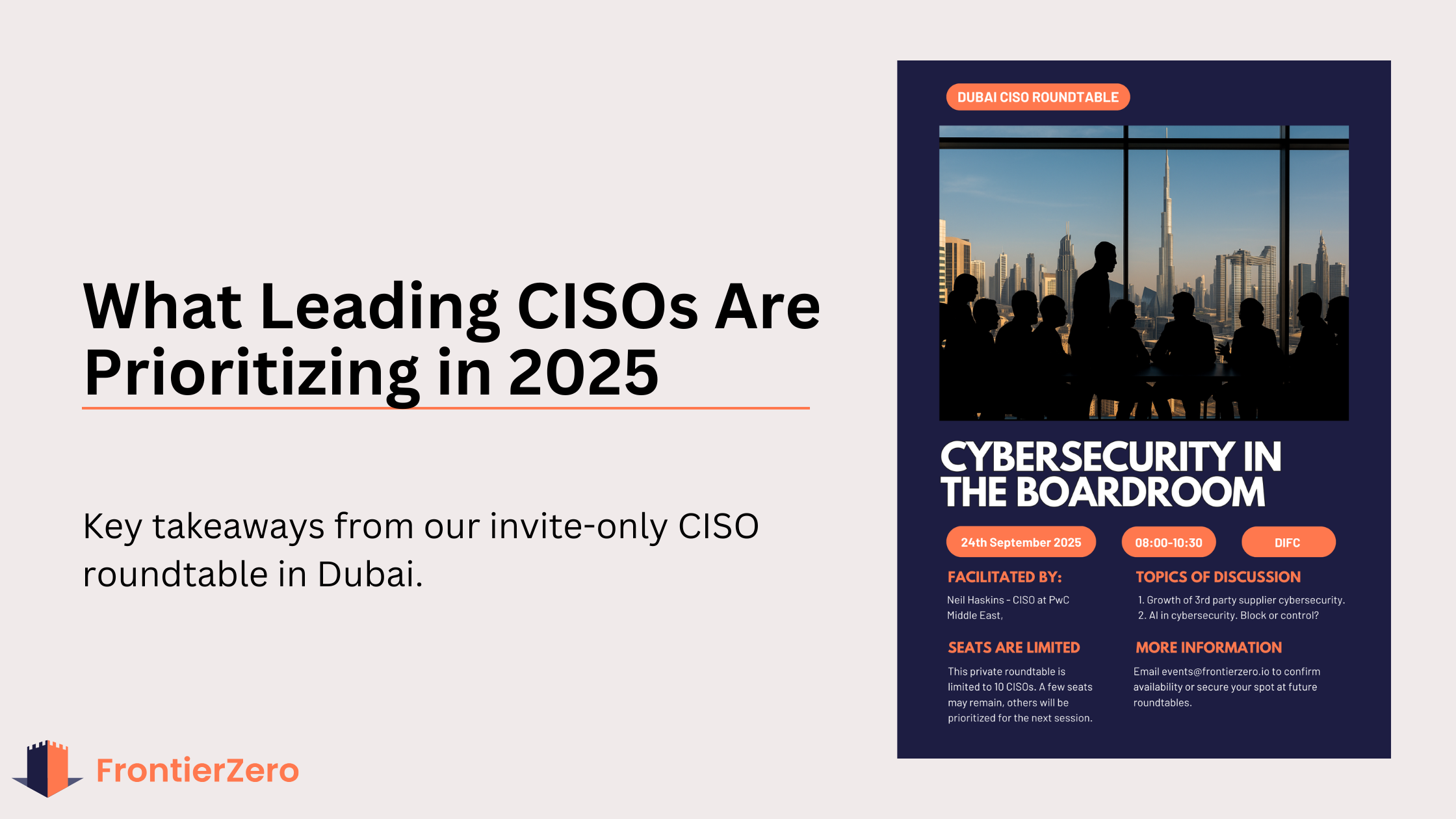
Key takeaways from the FrontierZero Cybersecurity Roundtable
A few weeks ago, we brought CISOs and legal experts into the same room.
No vendor pitches. No slides. Just an open conversation about where enterprise security is actually breaking down.
What came out of it was more direct than most things published in this space. So we're sharing it here.
The Legal Angle Stopped the Room
The most striking moment of the roundtable came from the legal side of the table.
The argument was straightforward: if your insurer can demonstrate you had no real-time visibility into third-party activity inside your environment, they have grounds to challenge your claim. Periodic assessments do not constitute continuous oversight. And in the post-breach review, that distinction can invalidate a policy entirely.
The question has shifted from "did you assess your vendors?" to "what did you see, and when did you see it?"
Most organizations cannot answer that second question. That is the exposure. And it is compounded by where the insurance market is heading. Premiums are rising, underwriters are tightening requirements, and continuous monitoring evidence is increasingly what separates a paid claim from a denied one.
The Room Agreed: Periodic Assessments Are a False Sense of Security
Most enterprises assess their third-party vendors. Questionnaires go out. Audits get completed. Vendors get scored.
But here is what that process actually measures: the view from outside your vendor's firewall. It tells you how they present externally. It tells you nothing about what their employees are doing inside your environment once access is granted.
Then the cycle ends. And nothing moves again until a breach forces a review.
The consensus in the room was blunt: point-in-time assessments tell you what a vendor looked like on the day you checked. They tell you nothing about what that vendor's employees are doing inside your environment today. The threat does not wait for your next review cycle. A misconfigured integration can sit open for months. A vendor employee with legitimate credentials can access your Microsoft 365 environment and exfiltrate data between assessments without triggering a single alert.
Understanding what is happening from the inside out is no longer optional. Neither is ensuring MFA is enforced consistently across every SaaS application your vendors can reach. These are not advanced security measures. They are the baseline the room agreedroom agreed most organizations are still not meeting.
The monitoring gap is not a theoretical risk. It is where real breaches happen.
What Leaders Said Needs to Change
Three things came up consistently across the discussion:
- Vendor risk cannot be managed at the perimeter. Visibility needs to extend into what third-party employees are doing inside your SaaS environment after the connection is established.
- Behavioral monitoring is the missing layer. Not external scoring. Not one-time audits. Real-time insight into access patterns, anomalies, and activity that deviates from what a vendor should be doing.
- Compliance frameworks are catching up. UAE PDPL, NCA ECC, DIFC, GDPR, DORA, CYBER ESSENTIALS, ESSENTIAL8 requirements are tightening. Organizations that cannot demonstrate continuous oversight will face increasing regulatory exposure, not just insurance risk.
The Takeaway
Your perimeter is only as strong as the least-monitored vendor in your supply chain.
Most existing solutions stop at your known vendors' firewall. They map the connection. They do not monitor what happens after it. An inside-out approach changes that — giving you visibility into every vendor's activity inside your environment, not just the ones you formally procured and reviewed.
That was the conclusion of the room. Not ours alone. From CISOs and legal experts who deal with the consequences of this gap directly.
If you want to be part of the next roundtable, whether as a participant, a speaker, or an observer, reach out to us directly at [email protected]. We keep the groups small and the conversation honest.