SecurityScorecard Gives You the Outside View. Here's What It Can't See.
SecurityScorecard earns its place in vendor risk programmes. But once a vendor connects to your SaaS environment, the outside view goes dark. That is where most modern third-party breaches actually unfold.
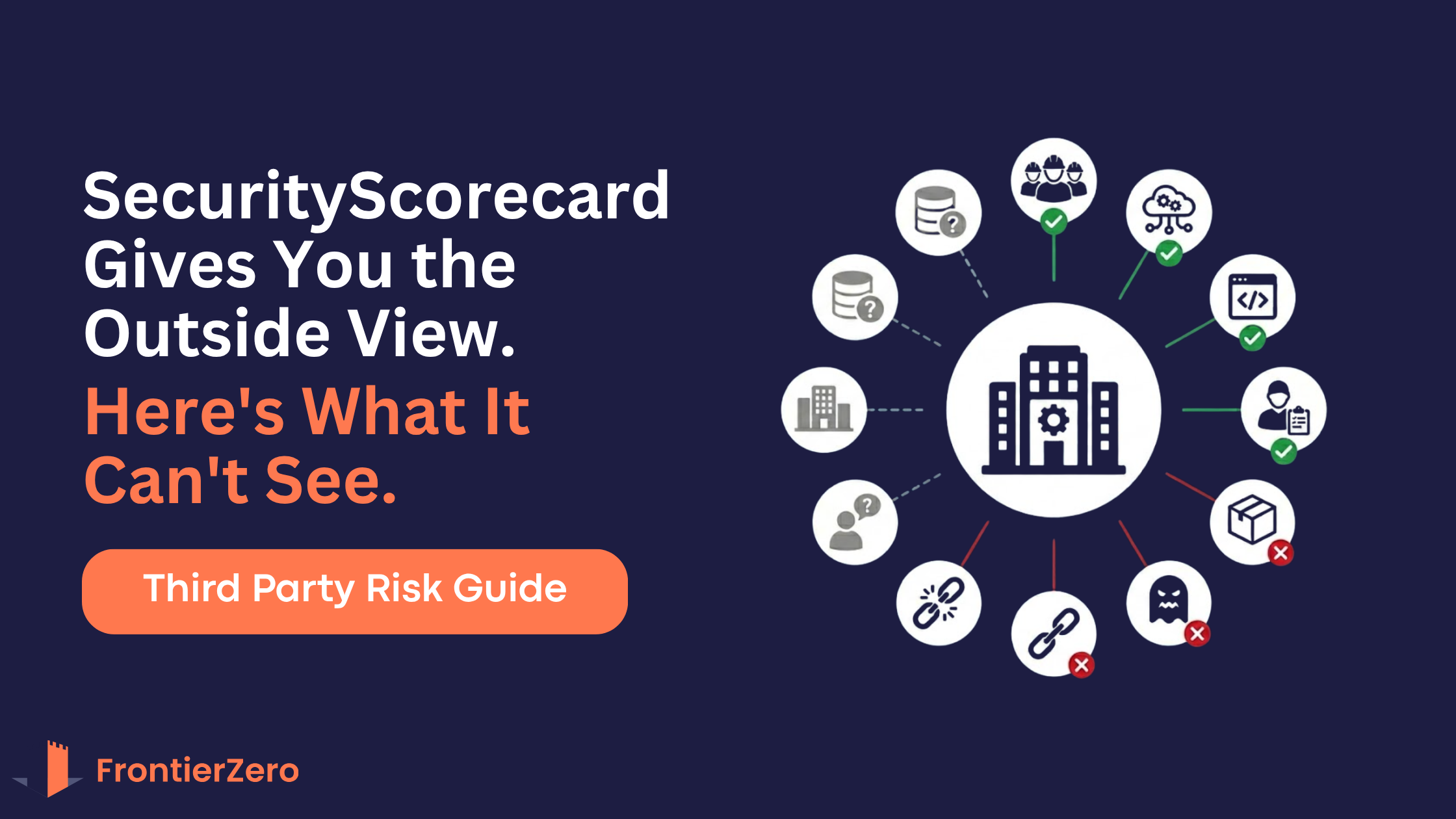
SecurityScorecard is one of the most capable external risk rating platforms available. Real-time scores updated from its own proprietary data, a published and regularly updated methodology, over 90 integrations, and Forrester-validated accuracy. For evaluating vendor security posture before and throughout a relationship, it earns its place.
The problem is not what SecurityScorecard does. It is what no external rating platform is built to do.
Once a vendor is inside your SaaS environment, the outside view goes dark. That is where most modern third-party breaches actually unfold, and it is the gap this article addresses.
What SecurityScorecard Does Well
SecurityScorecard's core function is collecting signals from a vendor's public-facing infrastructure: exposed services, botnet activity, SSL misconfigurations, and dark web credential leaks. It processes that data into a letter grade (A through F), refreshed continuously from data it owns and collects itself rather than sourcing from third parties.
That architecture matters. Forrester's Cybersecurity Risk Ratings Platforms Wave cited SecurityScorecard for strong data accuracy. Its methodology is publicly documented and updated regularly. Independent validation testing shows the scores correlate with real-world breach likelihood. When a vendor's grade drops, something has genuinely changed in their external posture.
In practice, that gives security teams three things:
- A questionnaire alternative at scale. Assessing hundreds of vendors through security surveys is not realistic. An external rating gives a defensible, data-backed view of supplier hygiene without the operational overhead.
- Early warning on posture changes. A supplier rated A in January could have a credential leak or exposed service by March. Near real-time scoring surfaces changes before they become incidents.
- Automation to operationalise it. With over 90 integrations and a rule-and-automation centre, SecurityScorecard connects to existing TPRM workflows rather than sitting in isolation.
The limitation is not accuracy. It is scope. SecurityScorecard sees the infrastructure that a vendor controls. It does not see what a vendor does inside your environment.
The Gap: Access Is Not Infrastructure
An A-rated vendor can still be the source of your next breach.
Not because the rating is wrong. Because the rating is measuring the right thing in the wrong place.
When a third party connects to your Microsoft 365 tenant, your Salesforce org, or your Google Workspace via OAuth or delegated admin credentials, they stop being an external entity. They are operating inside your environment, with whatever permissions were granted at the time of connection. External scanning has no view into that.
A realistic scenario:
- A vendor integrated with your Microsoft 365 environment six months ago for a project.
- The project ended. The OAuth token did not expire.
- One of their employees' credentials was included in a breach dump last month.
- That account still has read access to SharePoint and the ability to enumerate your user directory.
- Their SecurityScorecard grade today: B.
None of that shows up in an external rating. The exposure is not in the vendor's infrastructure. It is in a persistent connection inside yours that no one audited after the engagement closed.
The HackerOne breach followed this pattern: authorised contractor access, not a failing score. So did the Jaguar Land Rover breach, the Vimeo breach, and the Zara breach. In each case, the signal was inside the environment. No external rating would have caught it.
The Split: Outside View vs. Inside View
There are two distinct questions in third-party risk. Most programmes only have an answer to the first.
Outside view: Is this vendor secure? What does their external infrastructure look like? Are they maintaining hygiene, patching, and keeping credentials off the dark web? SecurityScorecard is built precisely for this. It is where it excels.
Inside view: What is this vendor doing in my environment right now? Which accounts are active? What can they access? Do any connections predate the current relationship or exceed the permissions that were agreed upon?
SaaS providers secure the platform layer. Everything that happens inside your environment (the identities, integrations, and vendor accounts operating within it) is your responsibility. A clean external grade says nothing about whether a vendor's employee account is still active six months after offboarding, or whether their OAuth integration quietly holds write access to data it was never meant to touch.
If you want the outside view: SecurityScorecard.
If you want the inside view: FrontierZero.
Neither replaces the other. They are monitoring different surfaces.
How the Two Layers Fit Together
What the Inside View Actually Covers
FrontierZero does not replicate what SecurityScorecard does. It starts where SecurityScorecard's visibility ends.
After a vendor is onboarded, the real operational question becomes: what do they still have access to, and should they? That is the layer most programmes leave unmonitored.
Concretely, that means tracking:
- Every OAuth connection and third-party app across your SaaS environment, including integrations employees granted independently without IT or security involvement.
- Individual vendor accounts, not just the vendor organisation. Who specifically is active, what are they accessing, and has anything changed since they were provisioned?
- Connections that have outlived the engagement. OAuth tokens and delegated credentials rarely expire automatically. FrontierZero surfaces access that was never revoked after a project or contract closed.
- Integrations with over-broad permissions. Where the scope of access granted exceeds what the vendor declared or actually needs.
This is the monitoring layer that maps to how third-party breaches actually happen. Not through external infrastructure failures, but through persistent, legitimate-looking access that nobody reviewed after it was granted.
The Shift Most Programmes Haven't Made Yet
External ratings solved a genuine problem. Before platforms like SecurityScorecard, there was no scalable way to assess vendor security posture without drowning in questionnaires. That was progress.
But vendor risk programmes that stop at the external layer are only half-built. The threat vectors that dominate breach investigations now are not misconfigured servers visible from the public internet. They are OAuth integrations granted and forgotten. Vendor accounts active long past their purpose. Shadow SaaS connections that bypassed procurement entirely and never appeared in any inventory.
External posture tells you whether it is reasonable to work with a vendor. Internal monitoring tells you whether the relationship is still safe to maintain. Most programmes have the first. Very few have the second.
Want to see what vendor connections are actually active in your environment?
FrontierZero's free External Connections Report maps every third-party integration across your SaaS stack, with risk context attached. No demo required.
Frequently Asked Questions
Does SecurityScorecard show what vendors are doing inside my SaaS environment?
No. SecurityScorecard monitors the external-facing infrastructure of a vendor: open ports, SSL configurations, credential exposures, and network hygiene signals. What happens after a vendor is granted access to your SaaS applications, which accounts are active, what permissions they hold, and whether access has been revoked, is a different monitoring layer that sits outside SecurityScorecard's scope.
If a vendor has a high SecurityScorecard grade, can they still cause a breach?
Yes, and this is true of any external rating methodology, not a limitation specific to SecurityScorecard. External grades reflect a vendor's public-facing posture. They do not account for the behaviour of individual employee accounts inside your environment, over-permissioned OAuth integrations, or access that was never revoked after an engagement ended. The HackerOne breach is a useful reference point: the vector was authorised access, not a failing external score.
How does FrontierZero work alongside SecurityScorecard?
They answer different questions. SecurityScorecard tells you whether a vendor looks trustworthy from the outside. FrontierZero tells you what that vendor is actually doing inside your environment: which accounts are active, what they can access, whether their permissions are appropriate, and whether any connections have outlived the relationship. The two tools are designed to work in parallel, not as alternatives.
What does third-party SaaS access monitoring actually cover?
It covers every vendor account, OAuth token, connected app, and delegated credential operating inside your SaaS environment. The focus is on behaviour and access state, not external posture. That includes flagging accounts still active after offboarding, integrations with broader permissions than declared, and connections granted by employees outside of any formal procurement or security review.
How do most security teams currently manage vendor access inside SaaS?
Most do not have full visibility. OAuth integrations are frequently granted by individual employees without IT involvement. Delegated admin accounts are provisioned during onboarding and rarely audited again. The result is an access layer that grows over time without corresponding oversight. FrontierZero's External Connections Report gives a complete inventory in minutes, with no cost and no demo requirement.