Best SSPM for GCC and UAE Organisations in 2026
Not all SSPM platforms are built for the GCC. This guide breaks down the top five options for UAE and Saudi organisations: what they cover, where they fall short, and which is built for your regulatory environment.
Most SSPM vendors were built for the US market. Their compliance frameworks reference HIPAA, SOC 2, and GDPR. Their case studies name Fortune 500 companies. Their support teams operate in EST.
That is a problem if you are a CISO in Dubai, Riyadh, or Abu Dhabi.
The GCC has its own regulatory reality. UAE PDPL, NCA ECC, DIFC data protection law, ADGM regulations, and the Saudi PDPL are not optional considerations that map neatly onto Western frameworks. They are enforceable obligations with local enforcement authorities, and the SaaS security tools your organisation relies on need to understand them.
This guide covers what GCC and UAE organisations actually need from an SSPM platform, how the regional regulatory landscape shapes those requirements, and how the leading platforms compare when evaluated against them.
What Is SSPM and Why Does It Matter in the GCC?
SaaS Security Posture Management (SSPM) is the category of security tooling that gives organisations continuous visibility into their SaaS environment: who has access to what, how applications are configured, what third-party integrations are connected, and where regulatory obligations are being missed.
If you want the full breakdown of what SSPM does and why traditional security tools miss the SaaS layer, read our full SSPM explainer here.
The short version: your firewall does not see what happens inside Salesforce. Your endpoint agent does not know that a vendor connected three months ago and has not logged in since. Your IAM solution manages identity at the door, but not what happens inside the room.
In the GCC, this matters more than most markets for three specific reasons.
Third-party exposure is high. Regional enterprises rely heavily on international SaaS vendors like US and European software companies, whose employees and support teams have OAuth access to sensitive environments. In environments FrontierZero has analysed, 46% of third-party vendor accounts were inactive for 180 days or more. Those accounts still had access.
Regulatory obligations are layered and local. A financial services firm in the DIFC answers to DFSA requirements. A healthcare organisation in Saudi Arabia answers to the Saudi PDPL. A government-adjacent entity in Abu Dhabi answers to ADGM and NCA ECC. None of these map cleanly onto each other, and no single US-built compliance template covers them.
The threat actors know this. Attackers increasingly target the SaaS layer precisely because most organisations have invested in network and endpoint security while leaving their SaaS environment largely unmonitored. The GCC, with high SaaS adoption and rapidly expanding digital infrastructure, is an attractive target.
The GCC Regulatory Landscape: What Your SSPM Actually Needs to Cover
Before evaluating platforms, you need to understand what compliance means in your jurisdiction. The GCC is not a single regulatory environment.
UAE PDPL (Federal Decree-Law No. 45 of 2021)
The UAE Personal Data Protection Law governs the processing of personal data for individuals in the UAE. For SaaS environments, this has direct implications: data processed through third-party SaaS applications is still your responsibility. If a vendor has OAuth access to employee or customer data and that vendor's access is unmonitored, you have a visibility gap that becomes a compliance gap under PDPL.
Your SSPM needs to show you which applications have access to personal data, under what permissions, and whether that access is current and justified.
NCA ECC (Essential Cybersecurity Controls)
Saudi Arabia's National Cybersecurity Authority Essential Cybersecurity Controls set baseline requirements for cybersecurity across critical sectors. ECC 1-5 (Identity and Access Management) and ECC 1-7 (Third-Party and Cloud Computing Security) are directly relevant to SaaS posture management. The controls require documented oversight of user access rights, third-party access governance, and continuous monitoring.
An SSPM platform operating in Saudi Arabia needs to produce audit-ready evidence against these controls, not just flag misconfigurations, but map findings to the specific NCA ECC requirements regulators expect to see documented.
DIFC and ADGM Data Protection Law
The Dubai International Financial Centre and Abu Dhabi Global Market each have their own data protection regimes modelled on GDPR principles but enforced locally. Organisations operating within these free zones face obligations around data processing transparency, access governance, and breach notification that extend into their SaaS stack.
The key implication for SSPM: data flows between SaaS applications (OAuth integrations, SaaS-to-SaaS connections, API-level data sharing) need to be visible and auditable. Most organisations have dozens of these connections that they cannot account for.
What This Means for Platform Selection
A GCC organisation evaluating SSPM platforms needs more than a generic compliance dashboard. You need:
- Mapping to NCA ECC controls specifically, not just GDPR or SOC 2
- Visibility into third-party vendor access at the individual account level
- Data residency clarity: where is the SSPM platform processing your environment data?
- Arabic-language support and regional deployment options where applicable
- A vendor that understands the local enforcement context, not just international best practice
The 5 Criteria That Matter Most for GCC SSPM Selection
1. Third-Party Vendor Behaviour Monitoring (Post-Connection)
Most SSPM platforms tell you that a vendor is connected. Fewer tell you what that vendor is actually doing after the connection is made. This is the critical gap.
In the GCC context, where international SaaS vendors have remote access to sensitive environments and local regulatory obligations require documented oversight, "connected" is not enough. You need to know whether the vendor's employee account is active, whether it accessed data last week, whether its permissions are appropriate for what it is actually doing, and whether it should still have access at all.
In environments FrontierZero has analysed, 42% of third-party accounts had no MFA enforced. These were not rogue connections; they were legitimate vendor accounts that had simply never been hardened.
For more on how SaaS supply chain risk works in practice and what happens when it is not monitored, see our breakdown of the HackerOne supply chain attack.
2. GCC Regulatory Framework Mapping
Your SSPM should map findings to the frameworks your regulators actually use. If your platform gives you a SOC 2 dashboard but your auditor wants NCA ECC evidence, you are doing double work, or worse, producing a compliance gap you cannot defend.
Look for explicit NCA ECC, UAE PDPL, and DIFC/ADGM mapping. If a vendor cannot name these frameworks in their product documentation, they are not built for your market.
3. Shadow AI and Unsanctioned Application Discovery
Shadow AI is the fastest-growing exposure category in GCC enterprise environments. Employees connect AI tools, like coding assistants, productivity apps, and AI-powered CRMs via OAuth without IT approval. These connections carry the same OAuth permissions as any other third-party integration, but they are often invisible to security teams.
Recently, a cybersecurity company found over 380,000 publicly accessible applications deployed across AI-native development platforms including Lovable, Replit, Base44, and Netlify. The majority were built and deployed without any security review. When employees connect these tools to corporate SaaS environments, the exposure is immediate and often undetected.
An SSPM platform operating in 2026 must actively discover and risk-score shadow AI connections, not just traditional SaaS applications.
4. Identity Visibility Across Vendor and Internal Accounts
Privilege creep, where users and vendors accumulate permissions over time without review, is one of the most common and most dangerous posture failures in enterprise SaaS environments. Contractors who became full-time employees and retained both sets of permissions. Vendors who started with read-only access and were granted admin rights for a specific project three years ago. Offboarded employees whose SaaS access was never fully revoked.
Your SSPM needs to surface all of it: internal accounts, external accounts, non-human identities, and dormant accounts, with enough context to act on findings without a manual investigation every time.
5. Deployment Speed and Operational Overhead
Enterprise SSPM platforms built for global Fortune 500 organisations are not always appropriate for the GCC market. Long procurement cycles, complex deployment requirements, and US-based professional services teams create friction. GCC organisations, particularly in financial services and government-adjacent sectors, often need visibility quickly, not after a six-month implementation programme.
The right platform for this market connects via API, delivers an initial risk picture within days, and does not require a dedicated internal engineer to maintain.
How Leading SSPM Platforms Compare for GCC Organisations
Is AppOmni available in the UAE? AppOmni is available globally and has enterprise deployments internationally. However, its compliance framework coverage is primarily US and global standards (SOC 2, HIPAA, GDPR). NCA ECC and UAE PDPL-specific mapping is not native to the platform, and regional deployment options for data residency are limited compared to platforms built specifically for this market.
What SSPM platforms support NCA ECC compliance? NCA ECC-specific compliance mapping is a differentiator that very few SSPM platforms have built natively. Most require manual mapping between their findings and the specific NCA ECC controls that your regulators expect. FrontierZero is one of the few platforms built with GCC regulatory frameworks as a primary design consideration rather than a retrofit.
FrontierZero
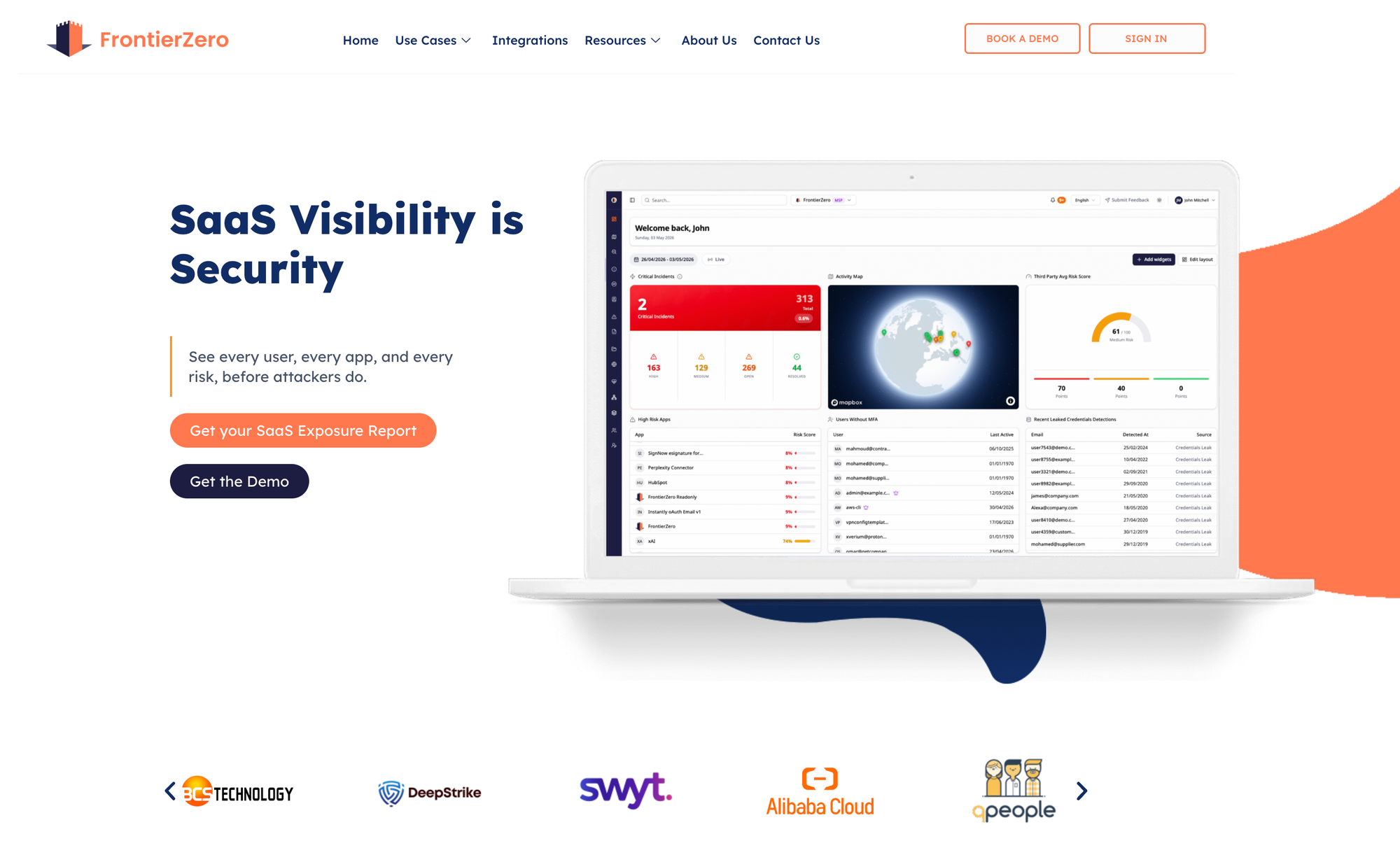
Built for the GCC market from day one. FrontierZero delivers SaaS posture management, third-party risk monitoring, shadow AI discovery, and identity visibility with explicit mapping to UAE PDPL, NCA ECC, DIFC, ADGM, and Saudi PDPL.
Its core differentiation in the GCC context is behavioural monitoring post-connection: FrontierZero does not just show you which vendors or AI tools are connected, it shows you what those accounts are doing, whether those accounts are current and properly secured, and what risk they carry to your regulatory posture.
Key data points from environments FrontierZero has analysed:
- 46% of third-party vendor accounts inactive for 180+ days but still connected
- 42% of external accounts operating without MFA
- 5 employees still using Deepseek AI, even after a company wide ban
- AI tool transmitting data to Taiwan, not to UAE as specified
- $150K in unnecessary SaaS spend identified in a single environment review
Deployment is API-based with no agents or browser extensions required. Initial visibility is delivered within days, not months.
Regional partnerships include AmiViz (Middle East and Africa) and CyberShield (Saudi Arabia), providing local implementation support and in-region account management, which matters for GCC organisations that need more than a US-based support ticket queue.
AppOmni
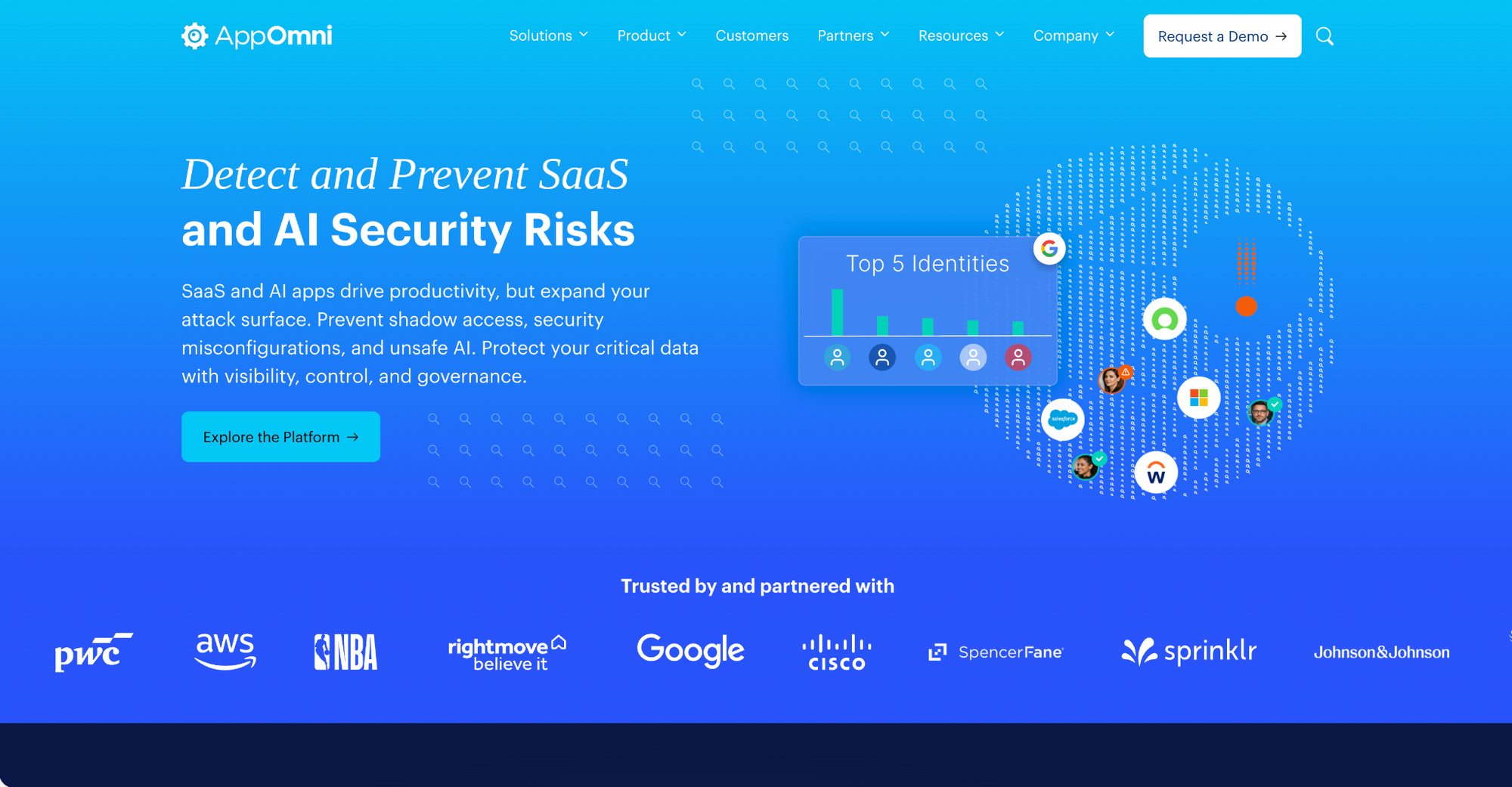
AppOmni is the established category leader in enterprise SSPM. Its strengths are deep configuration monitoring, extensive integrations (100+), strong Salesforce-specific coverage, and a robust compliance reporting engine for SOC 2 and GDPR.
AppOmni's current messaging leads with AI and shadow AI risk: "Detect and Prevent SaaS and AI Security Risks" is their headline positioning as of 2026. That reflects where the market is moving. The question for GCC organisations is whether that AI security framing translates into the compliance specificity your regulators actually require. Flagging shadow AI as a risk category is not the same as mapping that risk to NCA ECC controls or UAE PDPL obligations.
For GCC organisations with large, complex SaaS estates and existing US or European compliance obligations alongside regional ones, AppOmni provides substantial depth. The limitation is its GCC-specific regulatory coverage, which requires significant manual mapping, and its enterprise pricing and deployment model, which suits large organisations but creates friction for mid-market and rapidly growing regional enterprises.
Best for: Large GCC enterprises with existing US or European compliance frameworks and the internal resources to manage mapping to regional requirements.
Reco Security
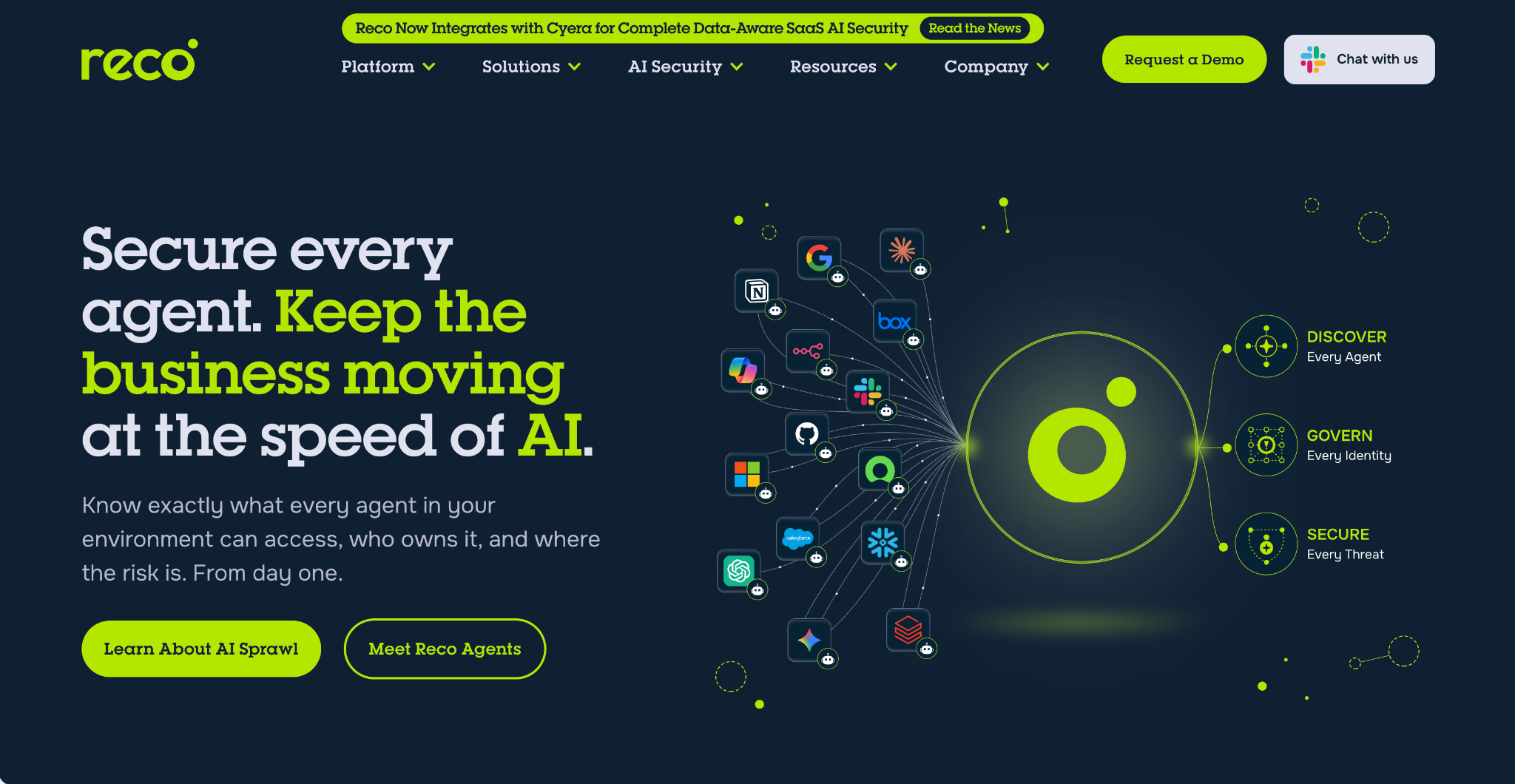
Reco focuses on identity-centric SaaS risk, identifying anomalous access patterns, unusual user behaviour, and risky third-party connections. Its approach is strong for organisations primarily concerned with insider risk and account compromise.
Reco's current positioning tells you where their product investment is going: "Secure every agent. Keep the business moving at the speed of AI." They have an AI Security tab in their navigation and a fresh integration with Cyera, positioning them around data-aware SaaS AI security. That is a legitimate capability direction, but it is also a significant pivot. For a GCC CISO whose primary concern is third-party vendor risk, regulatory compliance, and shadow SaaS exposure, Reco's roadmap is moving toward agentic AI governance rather than deeper GCC compliance specificity.
The gap in the GCC context remains third-party vendor behaviour monitoring at the depth regional compliance requires. Reco identifies that a vendor is connected and flags anomalies, but does not provide the granular account-level visibility into vendor employee activity that NCA ECC and DIFC oversight requirements demand. GCC regulatory mapping is also not natively embedded.
Best for: Organisations focused primarily on insider risk, user behaviour analytics, and AI agent governance, with compliance mapping handled separately.
Obsidian Security
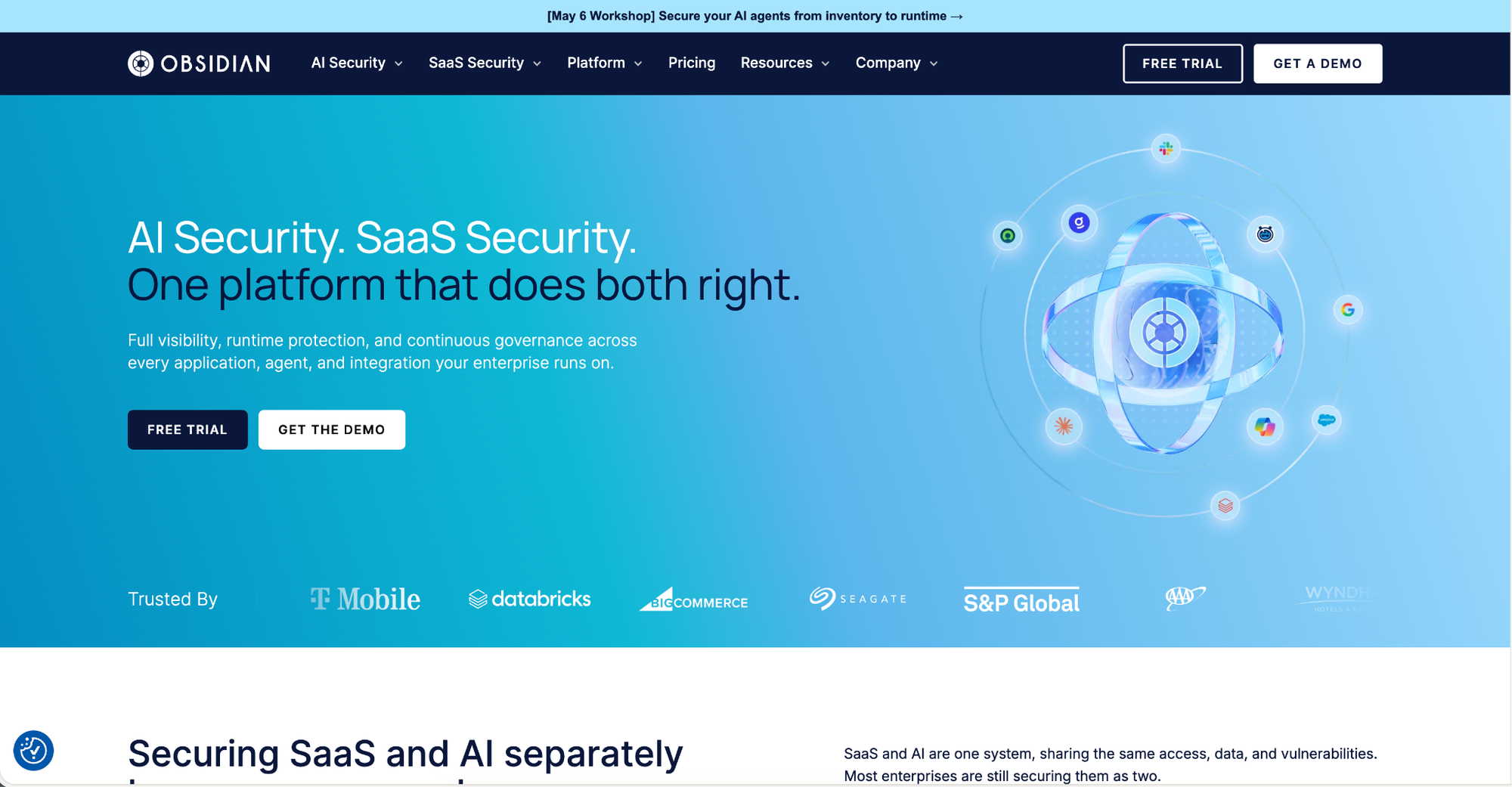
Obsidian Security brings strong behavioural analytics and is particularly effective for organisations with complex Microsoft 365, Salesforce, and Google Workspace environments. Its identity threat detection is mature.
Their current positioning: "AI Security. SaaS Security. One platform that does both right." reflects a clear pivot toward AI agent security, with separate product tracks for each. Their customer base tells the same story: T-Mobile, Databricks, S&P Global. This is a US enterprise-first platform, and it reads like one.
For GCC organisations, the core gaps remain: no native NCA ECC or UAE PDPL mapping, no account-level vendor behaviour monitoring, and no in-region deployment or partner support.
Best for: Organisations prioritising AI agent security and behavioural threat detection, with US or global compliance obligations as their primary framework.
Wing Security
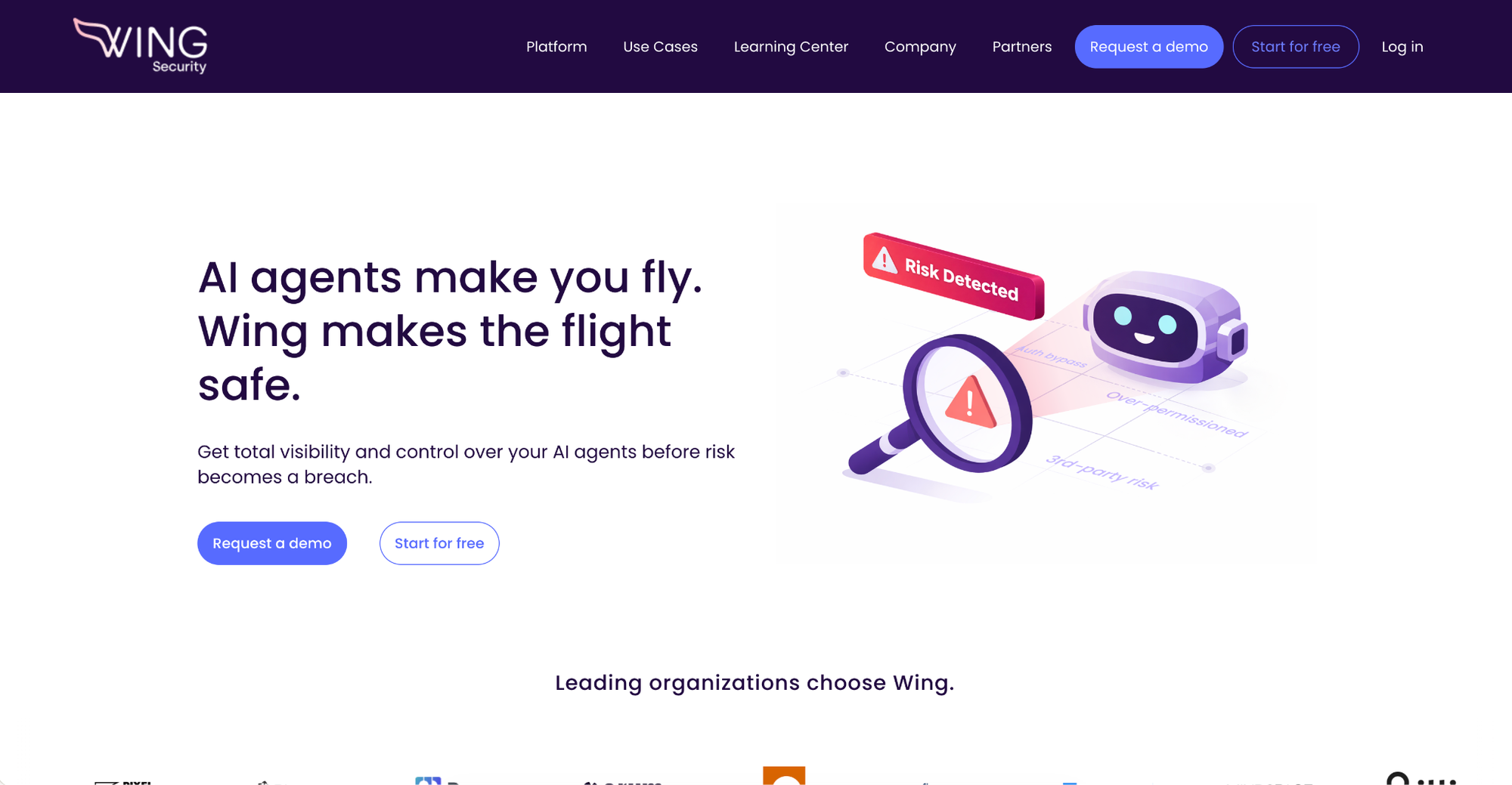
Wing Security has made a clear bet: "AI agents make you fly. Wing makes the flight safe." Their entire homepage is built around AI agent visibility and control, getting total oversight of AI agents before risk becomes a breach.
That is a focused product vision. But it is also a narrow one for a GCC organisation evaluating a full SSPM platform. Wing's strength is SaaS discovery and shadow IT mapping. It does not natively address NCA ECC, UAE PDPL, or DIFC requirements, and there is no documented in-region deployment or partner support for the Middle East.
If your primary concern is AI agent sprawl, Wing is worth evaluating. If your concern is third-party vendor risk, GCC regulatory compliance, and full SaaS posture management, it covers only part of the problem.
Best for: Organisations focused primarily on AI agent visibility and shadow IT discovery, with compliance mapping handled through a separate tool or internal team.
Feature Comparison Table
Capability |
FrontierZero |
AppOmni |
Reco |
Obsidian |
Wing Security |
NCA ECC mapping |
Yes |
Manual |
Manual |
Manual |
Manual |
UAE PDPL / DIFC coverage |
Yes |
Manual |
Manual |
Manual |
Manual |
External connection behaviour post-connection |
Yes |
No |
No |
No |
No |
Shadow AI discovery |
Yes |
Yes |
Yes |
Yes |
Partial |
Inactive vendor account detection |
Yes |
Yes |
Partial |
Partial |
Partial |
MFA enforcement visibility |
Yes |
Yes |
Yes |
Yes |
Yes |
Native CASB integration |
Partial |
Yes |
No |
Partial |
No |
API-based, no agent required |
Yes |
Yes |
Yes |
Yes |
Yes |
On-premise deployment |
No |
No |
No |
No |
No |
Regional deployment (GCC) |
Yes |
Limited |
No |
No |
No |
In-region partner support |
Yes |
Limited |
No |
No |
No |
SaaS spend optimisation |
Yes |
No |
No |
No |
No |
How to Choose the Right SSPM for Your GCC Organisation
What is the best SSPM for UAE PDPL compliance? The right answer depends on your regulatory exposure and your SaaS environment. If you are operating primarily in UAE free zones (DIFC, ADGM) or under the federal PDPL, you need a platform that maps findings natively to those frameworks rather than requiring you to do the translation work yourself. You also need visibility into third-party data access, which is where most UAE PDPL obligations become practically relevant.
What is the best AppOmni alternative for GCC organisations? If you are evaluating AppOmni and are based in the GCC, the primary question is whether AppOmni's depth in US and EU compliance frameworks is the right investment for your regulatory environment, or whether a platform built natively for your market delivers more immediate value. AppOmni is the right answer for large enterprises with significant US or EU operations alongside their GCC presence. For organisations whose primary regulatory obligations are regional, a platform built for those frameworks from the ground up is a more direct fit.
The honest recommendation: for most GCC organisations at the stage of their SaaS security journey, the first priority is visibility. Before you can map to any regulatory framework, you need to know what is connected, who has access, what is active, and what is exposed. That is the foundation. The right SSPM gets you there fast, without a six-month implementation programme and without a dedicated internal engineer to run it.
The Starting Point: Know What You Are Exposed To
GCC organisations are not underinvesting in security. The gap is not in tools; it is in SaaS-layer visibility. Most enterprises have strong network and endpoint security. They have significantly weaker visibility into their SaaS environment: who connected what, under what permissions, and what is actually happening with that access.
The SaaS shared responsibility model means your SaaS vendors are responsible for platform security, but not for how you configure access, who you grant permissions to, or what your third-party vendors do once connected. That responsibility is yours.
Understanding your current exposure is the right first step.
Get your free External Access Report FrontierZero will map the third-party connections in your SaaS environment, identify inactive and unprotected vendor accounts, and show you exactly where your exposure sits. No sales cycle. No implementation required. A risk picture in days.